>
Two thousand years old and still a working riverside town: the cliff-hung Qinglong Cave complex, the S-curve of the Wuyang River, dragon boats at Dragon Boat Festival, and Guizhou's most famous sour-fish table.
Four moments every visitor should not miss — the essence of Zhenyuan in a single day.
Any of the small piers by the old town: a hand-poled ferry carries you across the Wuyang for ¥1. It lasts a minute or two — and it is the cheapest, loveliest boat ride in China.
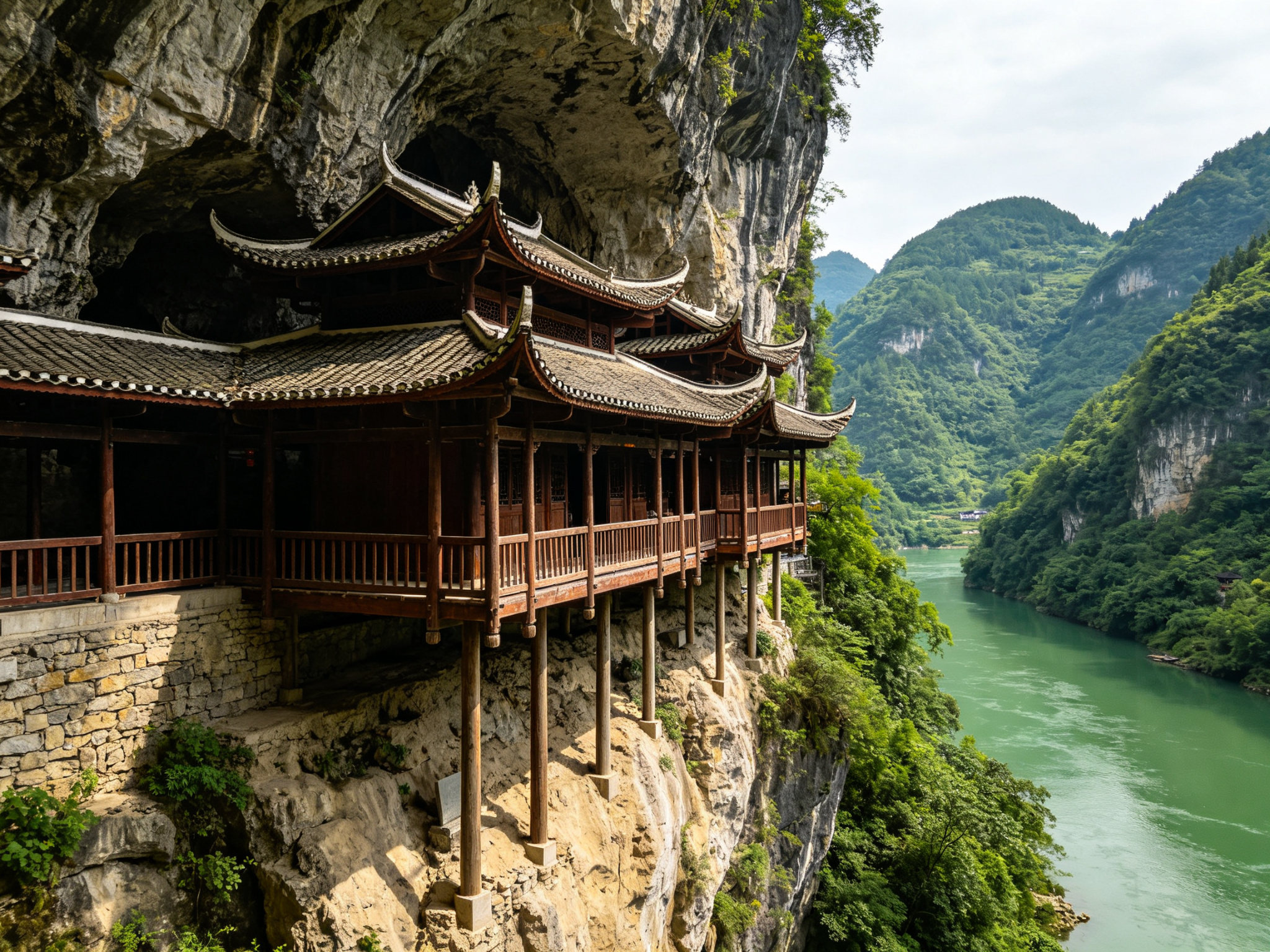
Not a cave at all — a Ming complex of halls and pavilions stacked on a cliff face, where Confucian, Buddhist and Taoist deities share rooms. "You in me, I in you": the harmony of three religions in one architecture.
Sleep river-side, and at night the Xiang-Qian railway traces a line of light across the gorge above the town — like the sky train of a Studio Ghibli film.
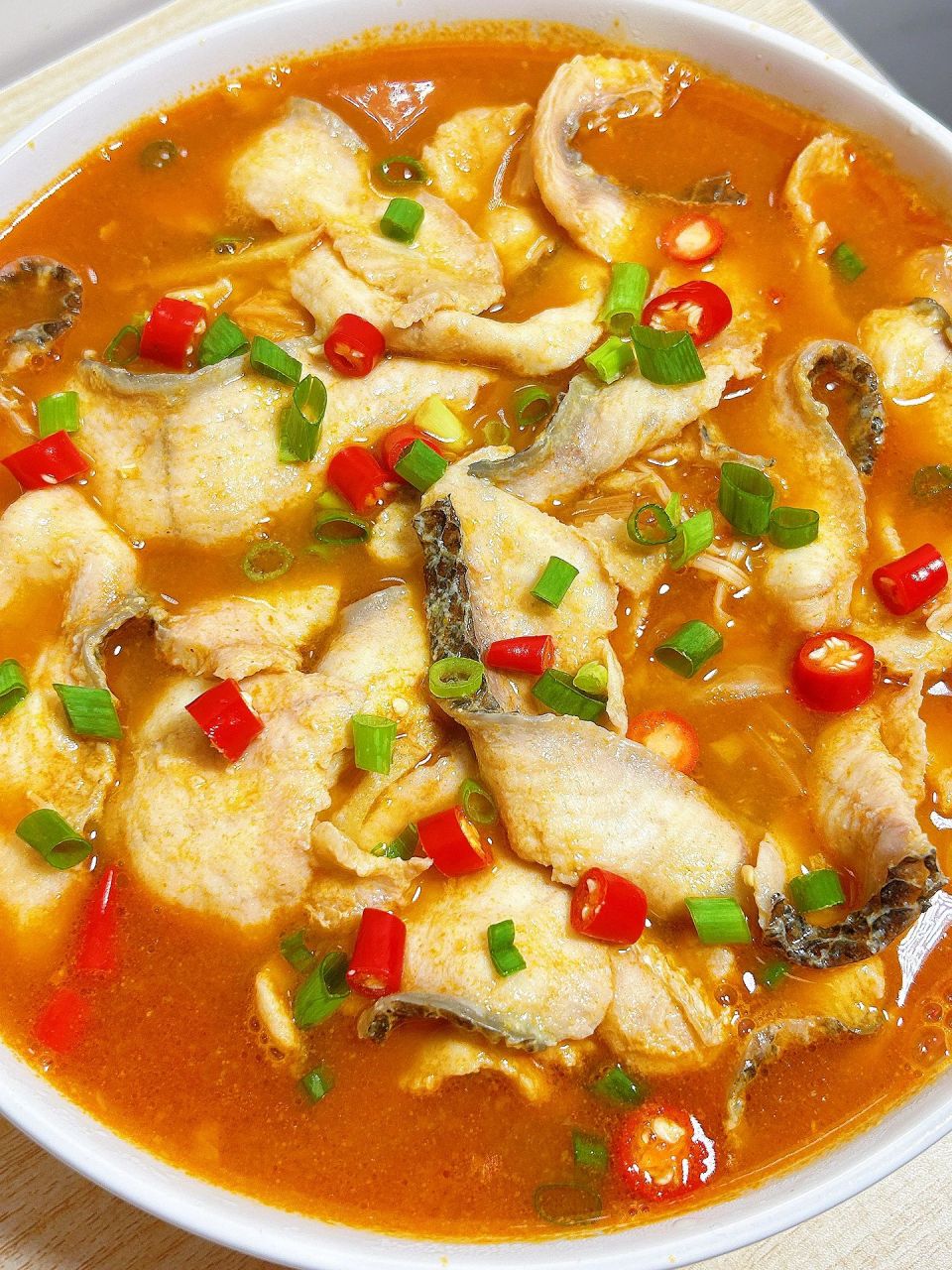
White sour, red sour, chilli sour — the three acid broths of Zhenyuan, made from fermented rice water, wild tomatoes and fermented chillies. One bowl and you understand why locals say "three days without sour, and walking makes you stumble."
The signature experiences of Guizhou's most beautiful river town.
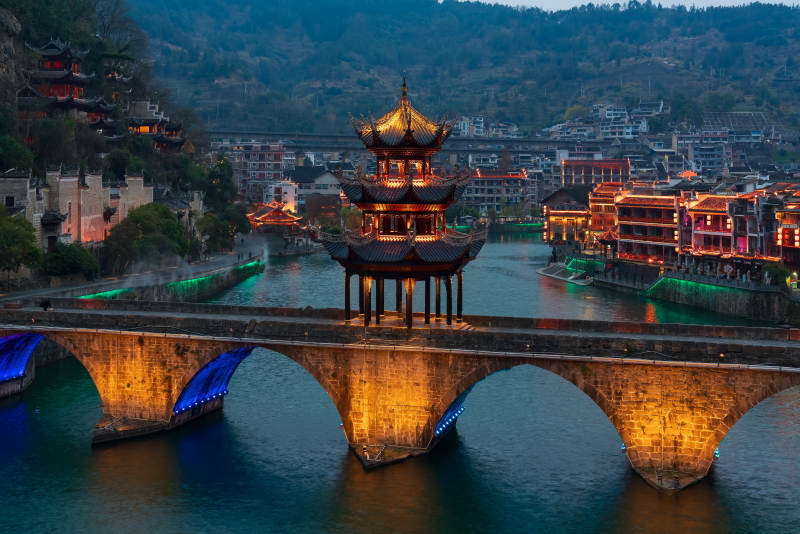
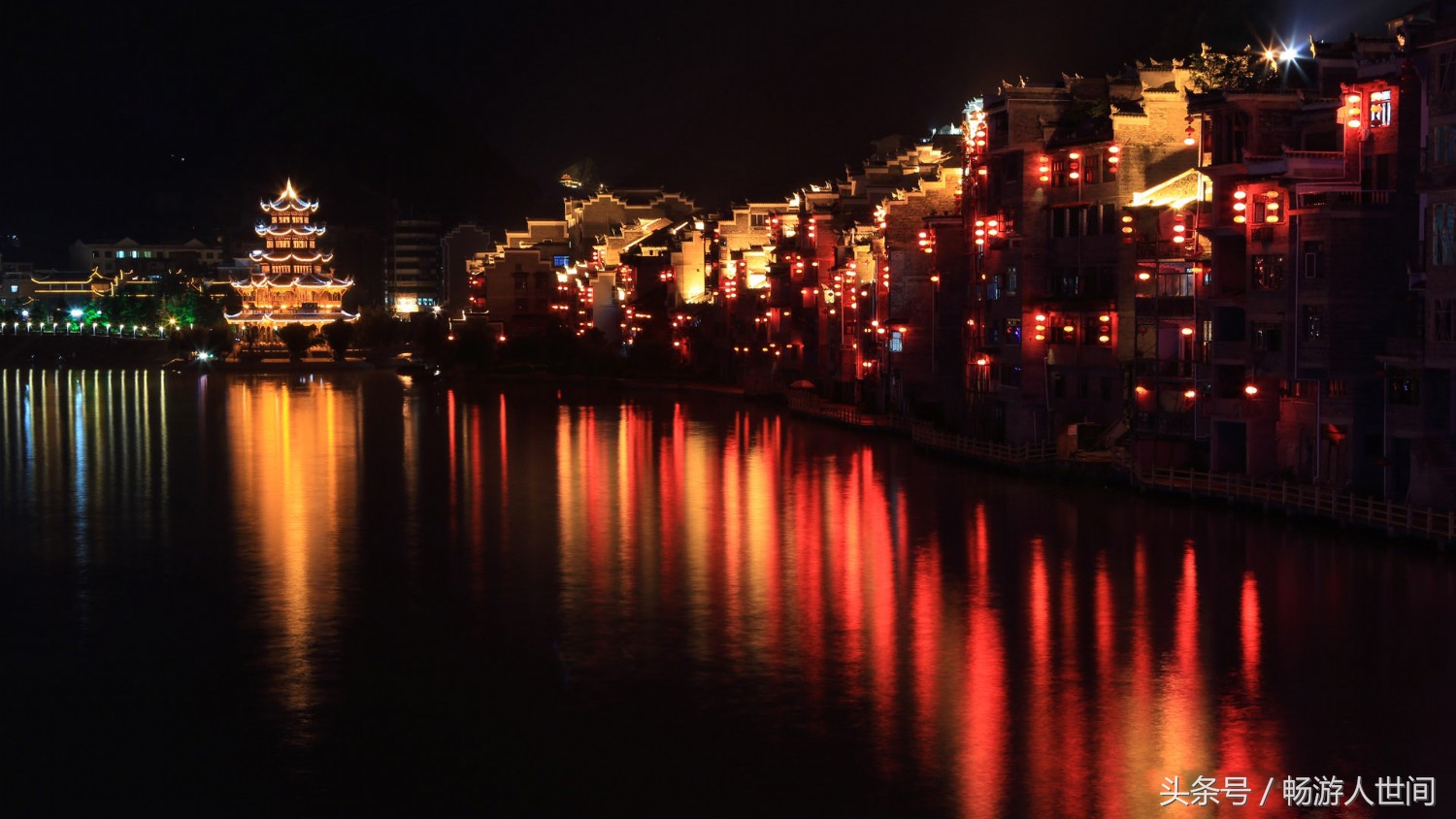
Green water in an S-curve like a jade belt through the town. Take the dusk ferry or a painted pleasure boat: lantern lights, reflected pagodas, and the whole old town glowing along the banks.
A national cultural treasure built onto a karst cliff: halls, pavilions and plank paths hanging above the river. One of the three great cliff-hung monasteries of southwest China.
The covered pavilion bridge that frames every postcard of Zhenyuan — best in the blue hour, when the timber glows warm and the river turns jade. The old lanes behind it hide 600-year-old courtyard houses.
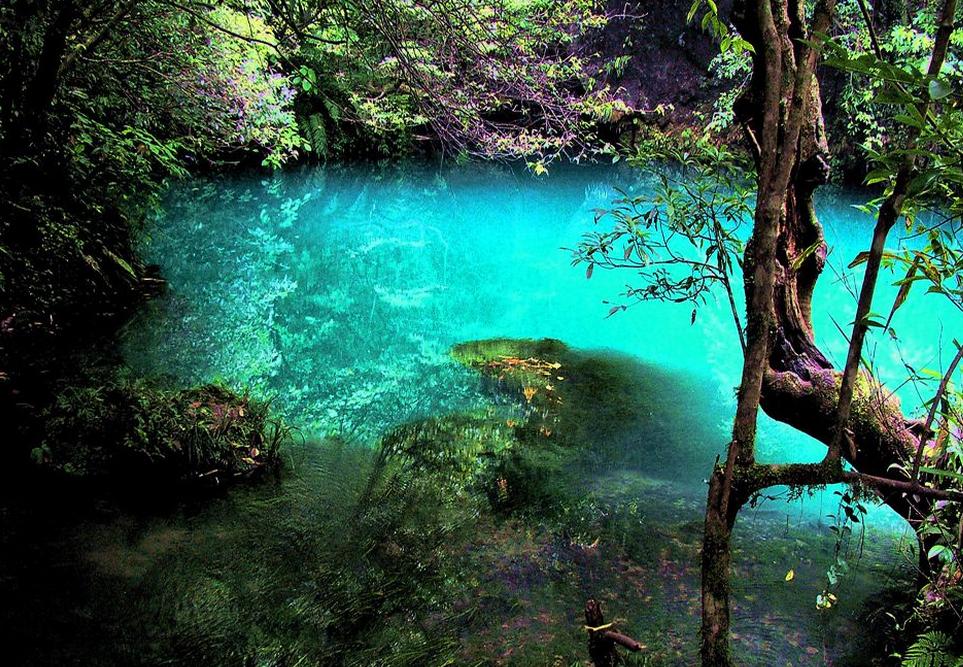
Tiexi Gorge, four kilometres from town, hides a Dragon Pool of impossible sapphire blue — legend says a dragon lives beneath it. Forest, grottoes and a gentle hike make it a half-day escape.
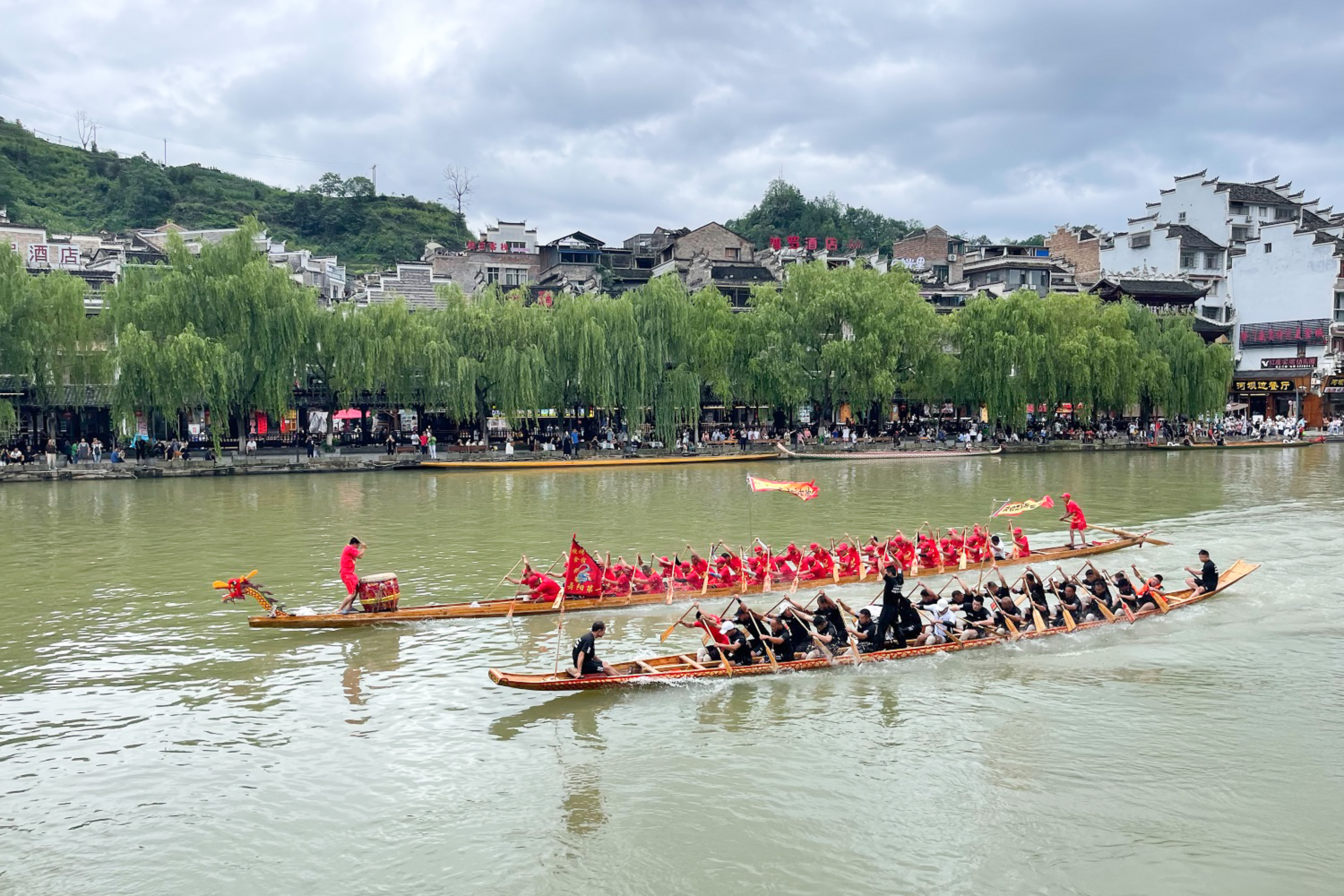
Every 5th day of the 5th lunar month, near a hundred thousand people crowd the banks: dragon boats, river lanterns and folk songs below the Qinglong Cave. One of Guizhou's great festival scenes.
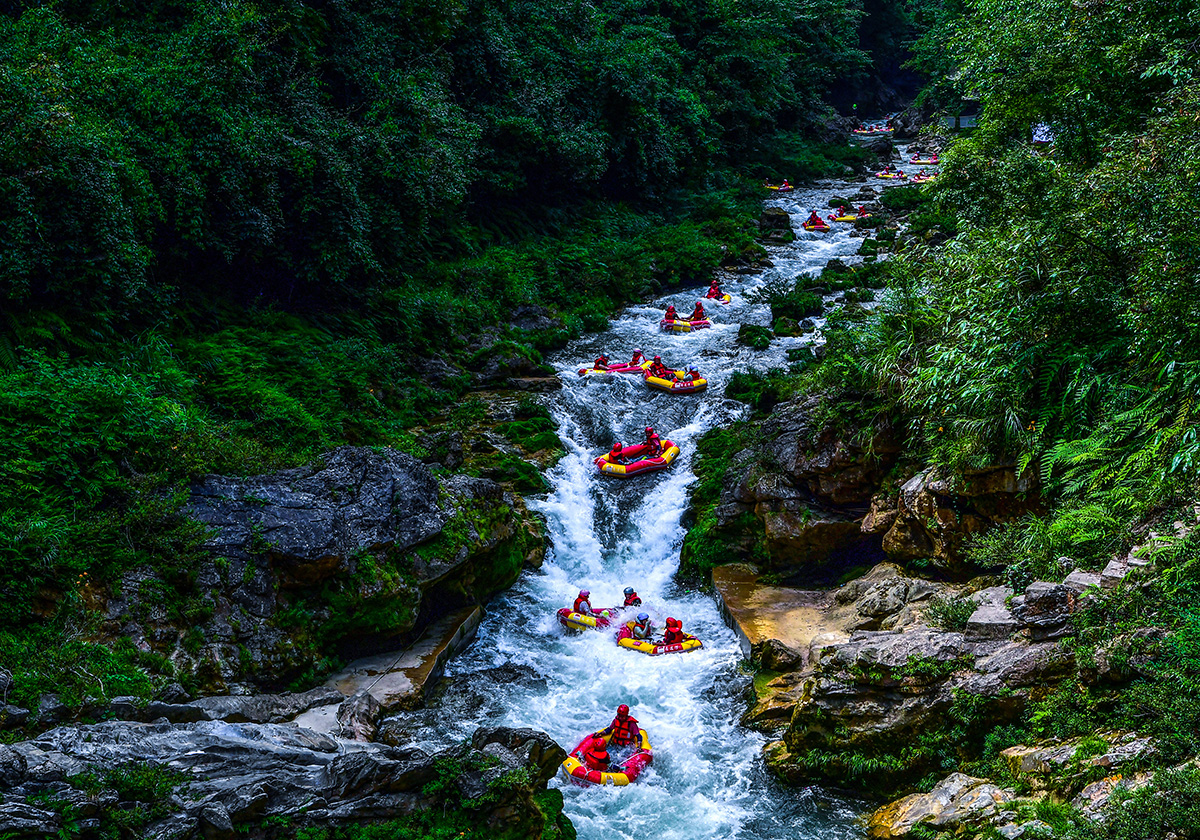
Ten kilometres of river dropping 200 m through primeval forest — Guizhou's emerald canyon. Half the run is gentle float, half is proper rapids; children must be over 1.4 m.
Spring, summer and autumn all suit the town — 80% of rain falls May–October, so pack an umbrella; summer storms can briefly affect transport. Winter is quiet and misty, lovely for photographers. More Zhenyuan Q&A →
National Day brings crowds, but beds remain findable — just expect higher prices. Standards are generally good: air conditioning, hot water and clean twins are the norm. Weekday rooms run ¥80–180; near the station, decent doubles exist from ¥50 off-peak if you bargain.
Trains are the safest and easiest: Guiyang–Zhenyuan about 4 hours, Kaili–Zhenyuan about 1 hour, Huaihua–Zhenyuan under 3 hours. By car, exit the expressway at Sansui or Yangxi and drive 40 km of provincial road; the Kaili–Huangping–Shibing route is scenic with few switchbacks.
Banks are everywhere: Agricultural Bank of China, ICBC and China Construction Bank all have branches in town. A UnionPay card with a little cash is the sensible mix.
Nights by the river are cool even in summer — bring a light layer. Diarrhoea remedies are useful for travellers eating unfamiliar spicy-sour food, and an umbrella for the rainy months.
Yes. Email [email protected] or message us on WhatsApp. Our team arranges hotels, train tickets, Gaoguohe rafting slots and guides — free of charge and without obligation.
The town's essentials on foot. More Zhenyuan itineraries with tickets & transport →
Old town walk. Start along the Wuyang riverbank, climb into the Qinglong Cave complex, cross the Zhusheng Bridge into the ancient lanes (look for the old courtyard houses and the iron-smelting history), then Tianhou Temple and the town-wall remains. Finish at dusk with the river lights from a ¥1 ferry.
Add rafting and wartime history. Full itinerary page →
The town. As the one-day route, ending with the night lights.
Gaoguohe rafting (~1.5 h drive) or the gentler Tiexi Gorge walk in the morning; in the afternoon, the Heping Village museum — China's only preserved WWII Japanese POW camp.
Cruise the Wuyang and climb the town's mountain. Full itinerary page →
The town. As the one-day route.
Gaoguohe or Tiexi, then the Heping Village museum.
Wuyang River cruise (2-h boat through the gorge, ¥100 boat + ¥20 entrance) in the morning, then Shiping Mountain for the town panorama and the Miao Great Wall (free entry before 7:00 / 8:00).
The town and its satellite sights, each with practical details. Prices are reference rates — always confirm at the gate or with our booking team.
Not a cave but a grand cliff-hung building complex: Zhongyuan Hall houses a Buddhist hall where the Taoist immortal Zhang Sanfeng once lodged, Ziyang Hall gives its finest room to the Taoist Laozi, and the first Taoist room is home to the Buddhist Guanyin — "you in me, I in you," three faiths in one architecture.
| Admission | ¥60 (reference); students half |
| Hours | 08:00–16:00 |
| Address | Zhonghe Mountain, east of Zhenyuan old town |
| Getting there | Walk along the river from the old town |
The jade belt that made Zhenyuan: a two-hour boat cruise through karst gorges, cliff temples and hidden waterfalls, plus a half-hour of shore walking — about four hours round trip from town.
| Admission | ¥20 (reference) + boat ¥100 |
| Hours | 08:00–17:30 |
| Getting there | Refurbished road, under 30 min from town; daily bus from Guiyang tourist coach centre |
| Time | ≈ 2 h cruise + 30 min walk |
Ten kilometres of river dropping 200 m through forested gorges — with the plateau's highest waterfall, the 108 m Guguandong Falls, on the free shuttle route. Two ways to play: the easy gorge walk, or the 4.8 km two-person raft run of 2.5–3 hours.
| Admission | ¥120 (reference) · Rafting ¥180, students half |
| Hours | 09:00–16:00 |
| Address | Yangchang Town, Zhenyuan County |
| Phone | +86 855 5871 099 |
| Kids | Rafting requires height over 1.4 m |
| Getting there | ~1.5 h drive from town via X011/Y002 |
A tributary of the Wuyang named for the iron-dark rocks of its banks, hiding a still, sapphire Dragon Pool so deep the locals say a dragon lives below. Primitive forest, grottoes and a gentle trekking trail make it the perfect half-day escape.
| Admission | ¥50 (reference) |
| Hours | 08:00–17:30 |
| Address | 4 km north-east of Zhenyuan old town |
| Best for | Hiking, photography, cooling off |
The hill behind the old town: climb for the full Zhenyuan panorama and the Miao Great Wall along the ridge — a Ming-era defence line of stone that local armies once garrisoned with 28,000 troops.
| Admission | ¥30 (reference); free before 7:00/8:00 |
| Best time | Early morning for light and free entry; dusk for the town lights |
| Note | Good paths but steep in places — wear grippy shoes |
Heping Village is the only preserved Japanese POW camp in China — from 1939 to 1944 it held more prisoners than any other camp south of the Yangtze, and its story of the Japanese anti-war league is told in the memorial hall. Nearby, the old lanes of the town hide courtyards, former guild halls and the relics of the Qingxi iron works, the cradle of Chinese heavy industry.
| Heping Village | Free · 08:00–17:30 (summer), 08:00–17:00 (winter) |
| Address | South section, Heping Street, Zhenyuan |
| Also worth it | Tianhou Temple ¥10 (new middle street) · Zhou Dawen Residence free |
Every 5th day of the 5th lunar month, nearly 100,000 people line the Wuyang: dragon boats racing below the Qinglong Cave, river lanterns, folk songs and a riverside fair. The biggest party on the river's calendar.
Painted pleasure boats (28-seat), performance boats, dragon boats and small fishing craft ply the town reach — with snacks, songs and the night lights. The budget way is any ¥1 ferry at a town pier.
Lunar 5/25–27, Miao villages of the Qingshui River launch their slender dugout dragon boats — a proud, ancient tradition with strict rituals and legends, crews standing in pairs.
Lunar 6/6: singing, lusheng flutes, horse races and bird fights. Lunar 8/8: the Tujia suona festival at Shangzhai, where players perform one, two or even three horns at once.
River-front rooms are the romantic choice but the worst for holiday price-gouging — shop around and bargain hard. Even in high summer you rarely need air conditioning here, so rooms without AC can be negotiated down. Our team books any of these free of charge.
By the river at old Weicheng Wharf, a 20-minute riverside walk to Qinglong Cave, with its own restaurant. Phone +86 855 5725 558.
Beside the Zhusheng Bridge facing Qinglong Cave: eight rooms, four river-side with balconies — the town's best photography perch. Phone +86 855 5725 808.
Honest-value rooms with computer options in the old town: street-side is cheaper but noisier, river-side pricier and nicer. Phone +86 855 5723 005.
Zhenyuan's only 3-star resort at the Tiexi entrance — 1 km from the old town, 6 km from the station. Phone +86 855 5726 116.
Run by two young owners who fell for Zhenyuan — bright, indie-decor rooms for the small-and-fresh crowd. Phone +86 855 5711 118.
If you catch an early train, sleep by the railway station: clean doubles from ¥50 off-peak with a bit of bargaining — a genuine secret of Zhenyuan.
Zhenyuan's table is built on sour: white sour (fermented rice water), red sour (wild tomatoes) and chilli sour (fermented chillies). Most restaurants serve similar menus — the difference is the price tag, so read the menu and follow the crowd.
The signature dish: fresh river fish in bubbling red sour soup, from milky-white to fiery red. The classic pick is Miaoweifang opposite the Daheguan Wharf.
A hidden lane house off Heping Street — wholly handmade, no additives, loved by locals. "Three days without sour, and walking makes you stumble." Phone +86 135 0855 0873.
Perfectly authentic sour fish at honest prices — the taste of home for Zhenyuan people who left. Phone +86 150 8621 3409.
"Pinch your nose at the smell, melt at the taste" — crisp outside, silky inside, the town's one and only shop. ¥4 a box.
Zhenyuan's rice tofu is famously white and silky because of the local water — served with chilli, spring onion, soy and crisp soybeans. The Huaxi-style beef noodles add a rich, peppery broth.
A century-old mustard-green pickle born in the Qinglong Cave Taoist temple — steamed with pork belly until glossy, dark and fragrant. Zhenyuan's famous export.
Guizhou's mountains make trains the safest, easiest option: Guiyang–Zhenyuan ~4 h, Kaili–Zhenyuan ~1 h, Huaihua (Hunan) under 3 h.
Long-distance buses serve Zhenyuan from Guiyang, Kaili and Hunan, and a daily coach runs to the Wuyang River scenic area from Guiyang's tourist coach centre.
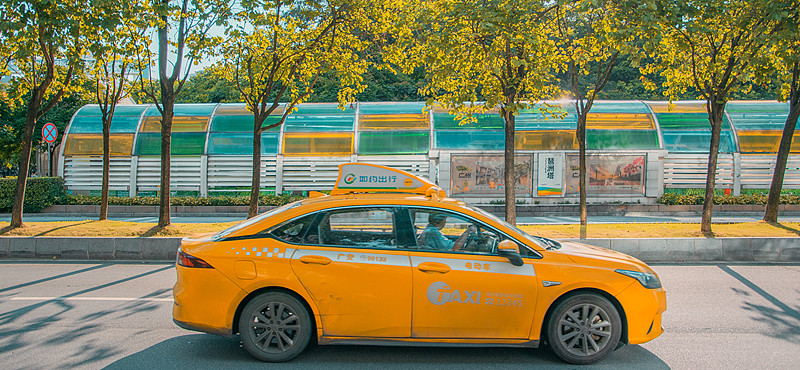
Anywhere in town is roughly ¥5 — but Zhenyuan taxis often charge per head rather than per car, so agree the total before boarding.
Town piers run hand-poled ferries across the Wuyang for ¥1 a ride — 1–2 minutes of river magic, and the quickest way to the other bank.
Exit the expressway at Sansui or Yangxi for 40 km of provincial road; the Kaili–Huangping–Shibing line is prettier and nearly free of switchbacks.
Zhenyuan is made for walking: the riverbank, the Zhusheng Bridge, the old lanes and the cliff-hung halls all sit within one comfortable day.
Qingjiu wine — aged in karst caves, crystal-clear with a long, sweet finish. Tianyin tribute tea — a 1,200-year-old tea from Tianyin village in Duping, hand-processed and altitude-grown. Aged Daocai — the century-old mustard pickle of the Qinglong Cave temple. And ginger sugar, pulled and twisted hot at street stalls with a performance worthy of the show itself.
Walk the two pedestrian streets, Xinglong and Shuncheng, where tourist shops sell all four specialties plus minority dress and small trinkets. Buy ginger sugar warm from the pullers, daocai by weight, and tea by the tin.
Zhenyuan County People's Hospital — Wuyang town · +86 855 5723 518. ABC (54 Heping Street, +86 855 5722 412), ICBC (28 Xinglong Street), CCB (2 Ximen Street) and the post office (Xinglong Street, +86 855 5722 261) cover the basics.
Zhenyuan is in the Qiandongnan area code — phones here begin +86 855. Emergencies: dial 120 (ambulance), 110 (police). For help with bookings, email [email protected] or WhatsApp our team any time.
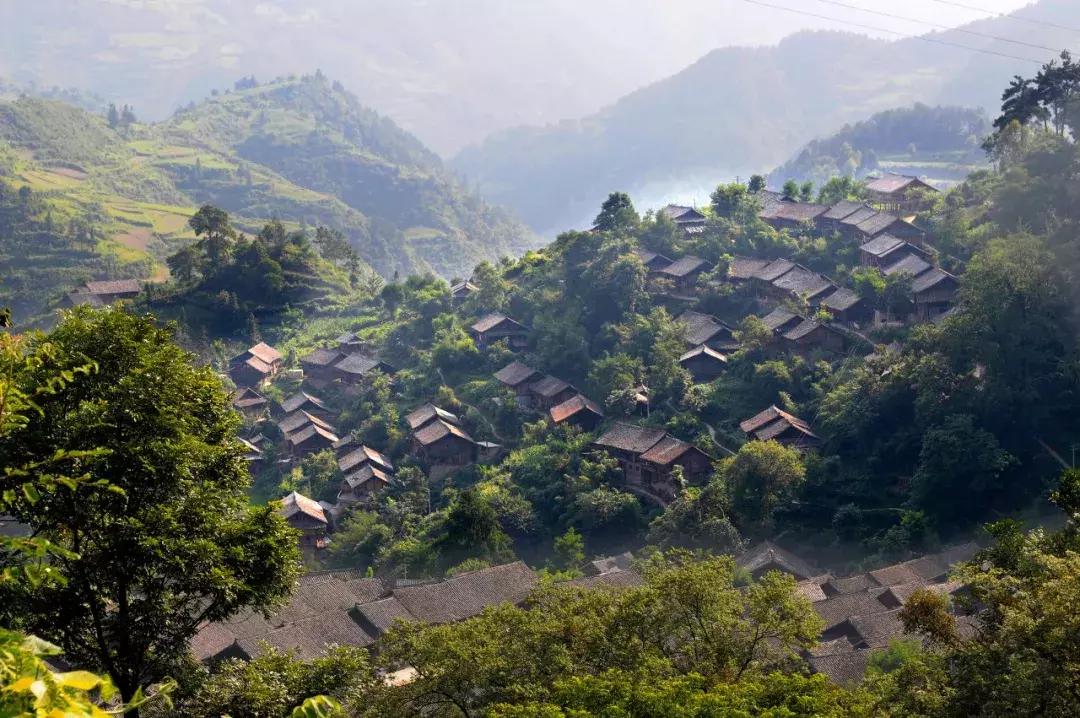
Thirty-nine kilometres south: the largest North-Dong village in China, 300 years old, 400 households and 2,000 people in all-timber stilted houses. No western-style buildings here — just dry-column Dong houses climbing the hill.
Baojing guideA full-day adventure: drive 1.5 hours into the emerald gorge, walk the shuttle route to the 108 m Guguandong Falls, then ride 4.8 km of mixed calm and rapids back to the base. Kids over 1.4 m welcome.
Gaoguohe guideEven in summer, evenings by the Wuyang turn cool — carry a light layer and keep the diarrhoea remedies handy for the spicy-sour table.
Hotels, ferries, taxis and even snacks: Zhenyuan is a town where prices are made to be negotiated. River-view rooms at holidays especially — compare, then cut.
Peanut-stuffed zongzi in green-tinted rice, ¥1 each from old-lane vendors; stinky tofu at ¥4 a box; ginger sugar pulled warm on Xinglong Street.
Many through-trains sell standing room only. Pick early departures, arrive early at the station, and you will ride seated.
Qinglong Cave and the temple halls are beautiful — just decline fortune-tellers and incense sellers with a smile. They are not part of the experience.
Zhenyuan is subtropical and humid — mild 16.4°C year-round, with rain to match: no bitter winter, no scorching summer, warm springs and autumns. It sits at the confluence of mountain, river and gorge country, "nine parts mountain, half part water, half part field."
Zhenyuan is a town built by soldiers and merchants: "Who holds Zhenyuan holds the gateway to Yunnan and Guizhou." From Qin-Han times (Wuyang county was its Han ancestor) through the Ming garrison era — 28,000 troops stationed here, four war-god temples, a Miao Great Wall on the ridge — to the Qing, when it was the key post station of the southern Silk Road to Burma and India. Its guild halls and theatres earned the name "the labyrinth of traditional culture."
In the Self-Strengthening Movement, Li Hongzhang and Zhang Zhidong founded the Qingxi Iron Works in Zhenyuan — three years before the Hanyang Steelworks. Its ingot No. 1 ("the first ingot of Heaven") survives to this day, making Zhenyuan the birthplace of modern Chinese heavy industry.
Everything on ToursChinaTravel is bookable through our team by email or WhatsApp. Here's where each part of your Zhenyuan trip lives on the site.
Star-rated sight details — hours, tickets, phones and travel tips for every Guizhou attraction.
Browse Guizhou sights381 star-rated hotels across Qiandongnan — sorted by rating, all bookable by our team.
Book a Qiandongnan hotelRoutes, airlines and schedules for Guiyang, Liping and the Xiang-Qian rail line.
See China flightsLicensed agencies with addresses, phones and booking contacts for the village loops.
Find a Guizhou agencyTianyin tea, Qingjiu wine, daocai pickle and batik — where each is made and where to buy it.
Browse Guizhou specialtiesQiandongnan, Guiyang, Huangguoshu, Libo, Dalian and more — city by city, in one place.
Browse all guides