>
The world's only waterfall you can view from six directions — front, back, left, right, above and below. This guide covers the falls, the caves behind them, the old villages around, honest itineraries and how to book your whole trip.
Four experiences every first-time visitor should not miss — the essence of Huangguoshu in a single day's walk.
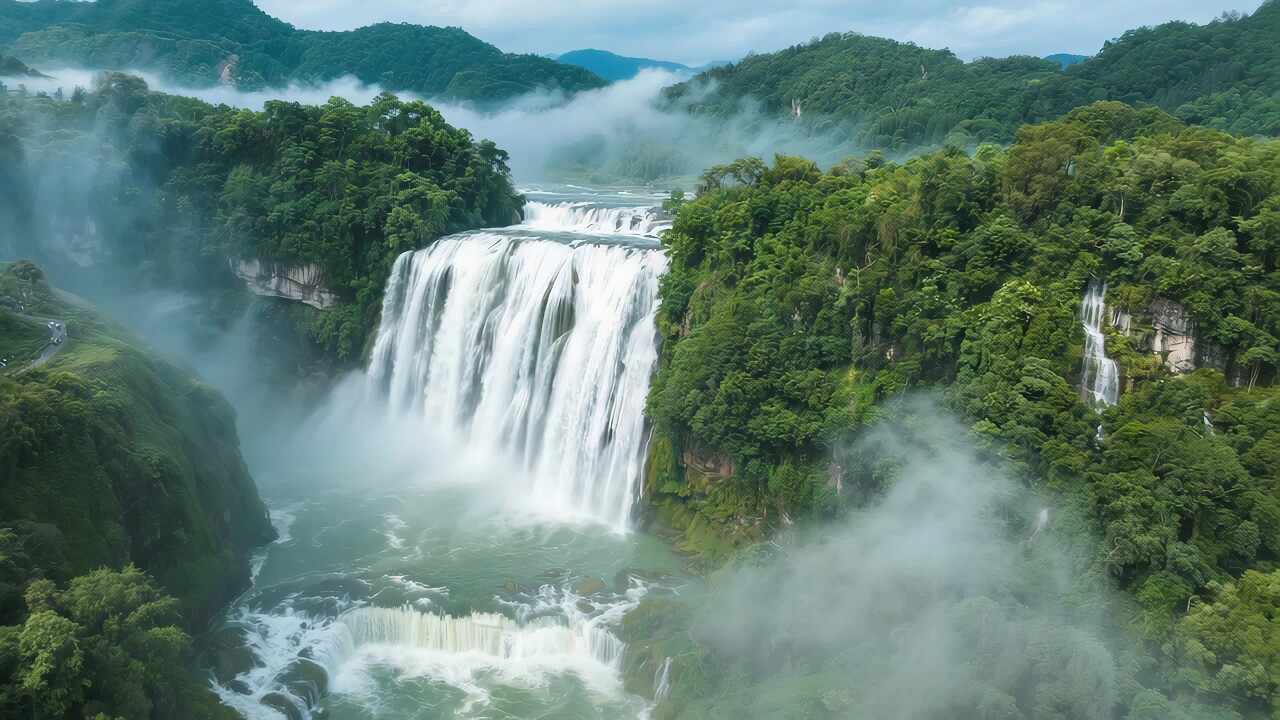
"No sight of the falls, but already the sound of water." The roar of 77.8 metres of river hits your ears a full valley before the view opens — then the mist and rainbow arrive together.
The Water-Curtain Cave runs along the falls' waist — six cave windows looking out through the curtain of water at the valley, tea houses and rainbows beyond.
Stone slabs, each engraved with a day of the year, lead through a water-woven garden of karst rocks — "wind-sword and water-knife carved a ten-thousand-pen garden."
Doupotang, the widest waterfall crest in the falls group (105 m), is the very place the pilgrims crossed in the 1986 TV series. Herons and egrets still fish at its foot.
Huangguoshu's signature experiences — the reasons travellers come from across the world.
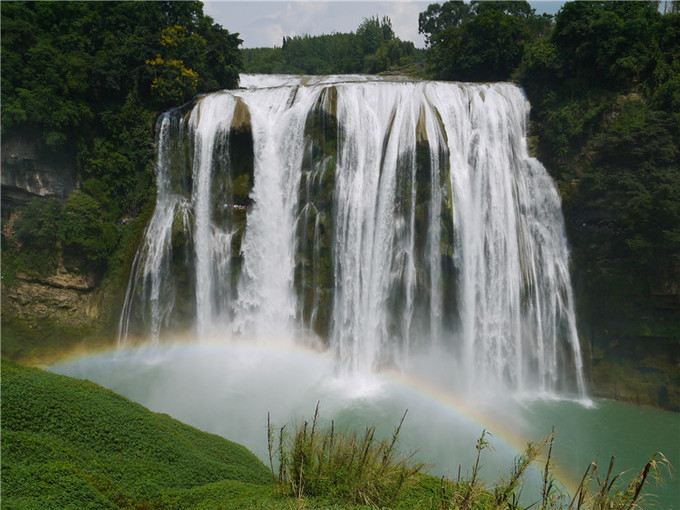
The world's third-largest waterfall after Niagara and Victoria — 77.8 m tall, 101 m wide, and the only one on Earth viewable from all six directions. In summer, the mist can soak you from fifty metres away.
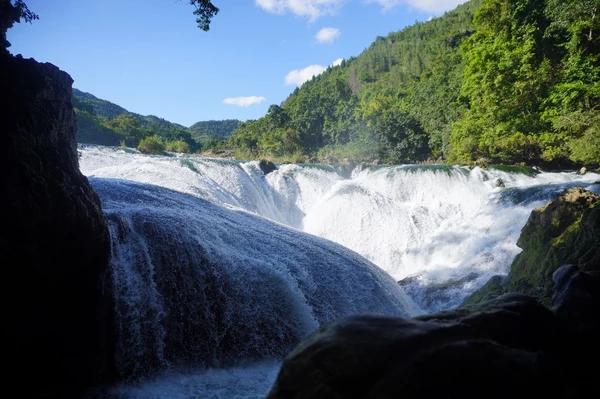
Six windows, five halls and three springs hidden in the falls' midriff. Peer through the falling water at the valley and the people below — and watch for the double rainbow over Rhinoceros Pool in the afternoon.
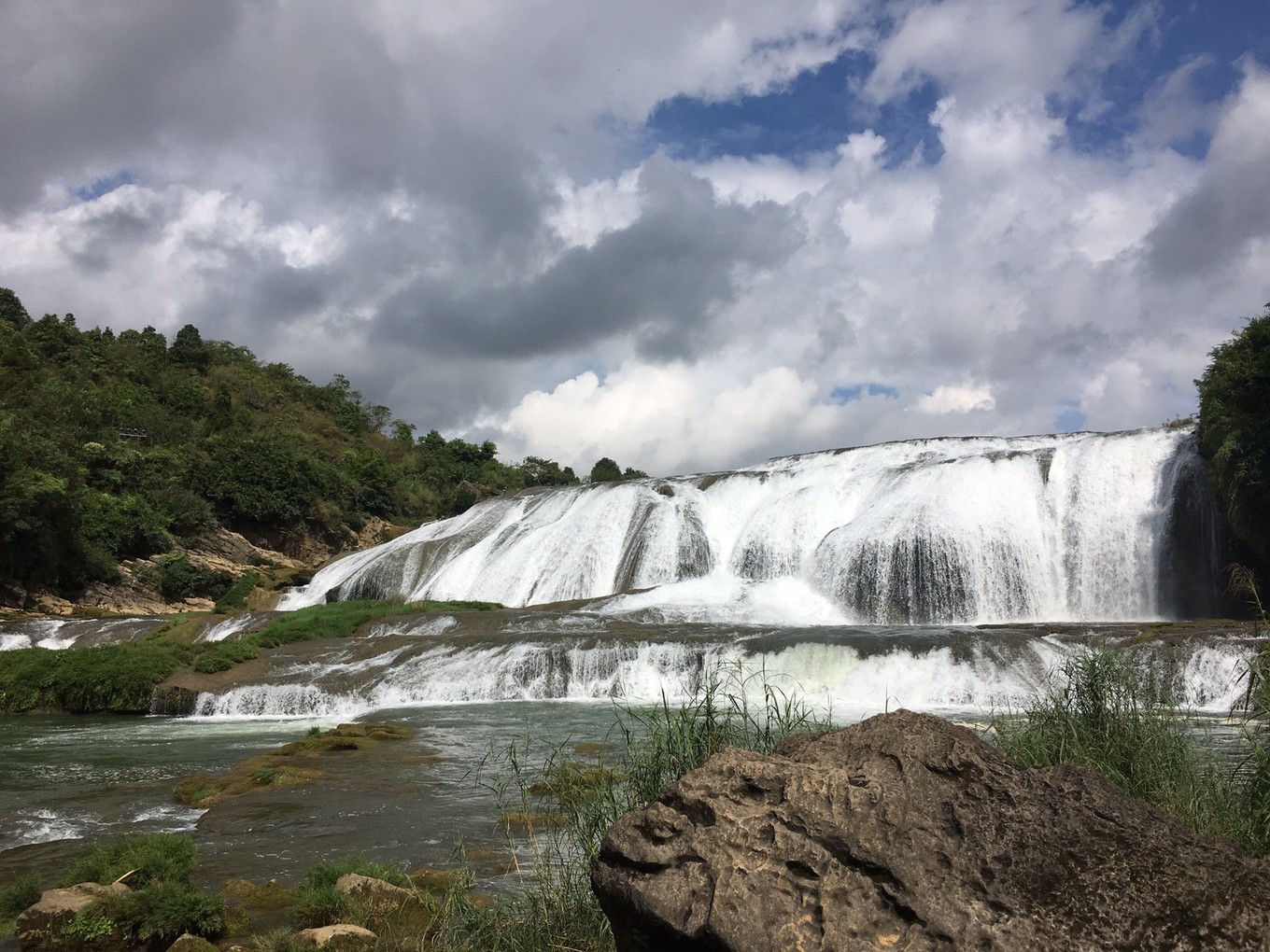
At 105 m wide, the group's widest falls — the very shot that opens the 1986 Journey to the West. Locals call it the Roaring Falls: before floods it growls a warning.
At Tianxingqiao, the Silver Chain Falls splits the river into thousands of silver chains over a funnel of calcite lotus leaves — the most beautiful waterfall in the whole Huangguoshu complex.
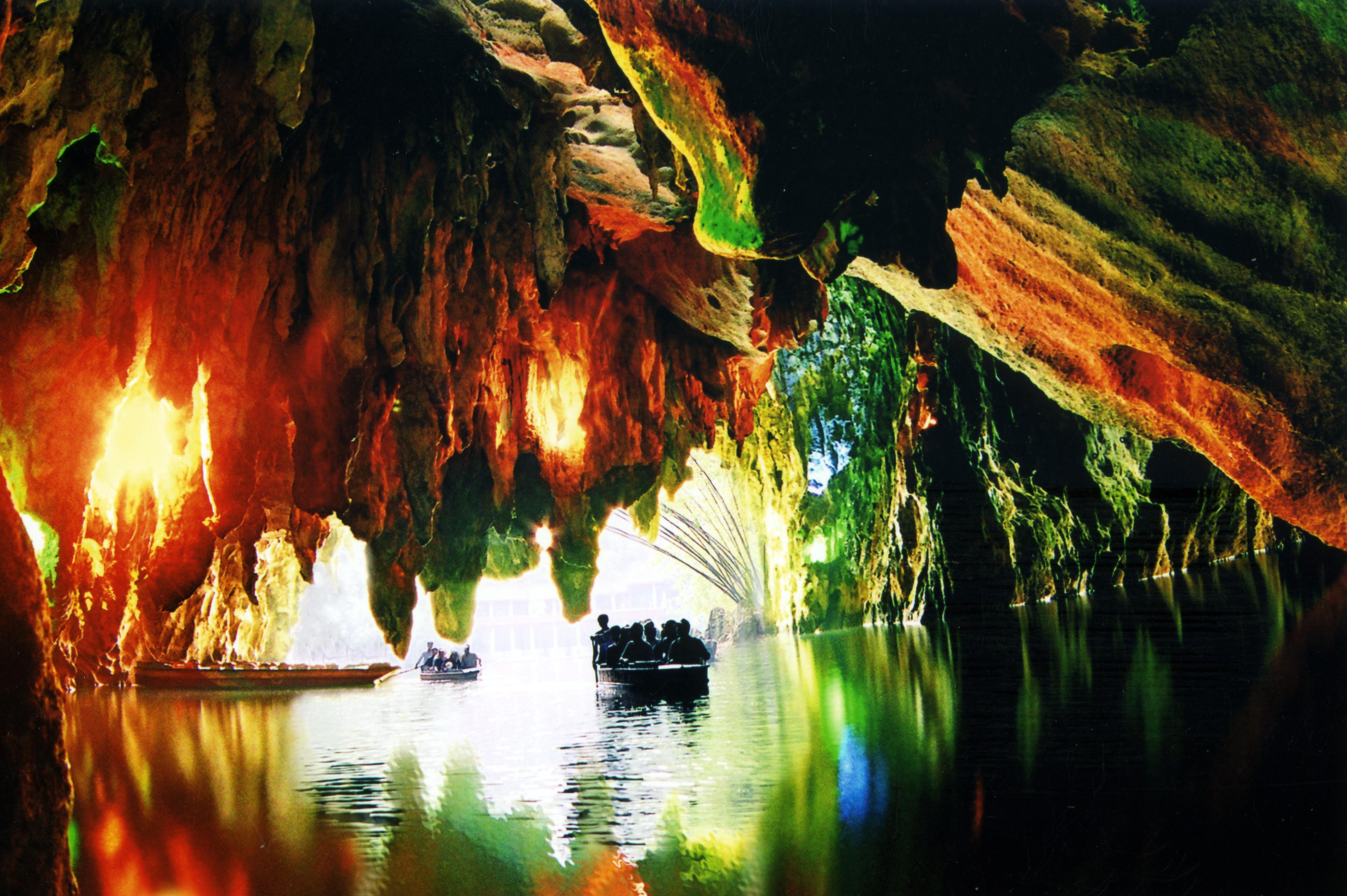
China's longest and loveliest water cave: 1,260 m of underground river by boat, past stalactites lit in colour, ending at the 50 m Longmen Flying Falls.
In the Tunbao villages, people still wear Ming robes and stage the ancient Nuo "ground opera" — soldiers' descendants frozen six centuries deep in Guizhou's hills.
Summer (June–September) brings the fullest water and the most dramatic falls — the rainy season pushes the river to its yearly peak. In dry winter months the falls shrink noticeably and the Silver Chain falls can dwindle. More Huangguoshu Q&A →
Fly to Anshun Huangguoshu Airport (45 km from the falls), or train to Anshun Station (1h10 from Guiyang, ¥15.5) and bus from the South Station (¥20). From Guiyang's Jinyang bus station, direct coaches cost ¥55 and take about 2.5 hours.
Hotels inside the scenic area are convenient but pricey. Around the entrance, family guesthouses run ¥60–200 — you can view the room and negotiate. Since the whole park is doable in one long day, many travellers sleep in Anshun or return to Guiyang for more choice.
Go independently if you can. Standard groups usually stop at Tianxing Lake (the Journey to the West filming spot) and skip Tianxing Cave and the Silver Chain falls — two of the park's best sights. The ¥50 shuttle-bus pass makes independent travel easy.
The combined ticket covers the Grand Falls, Tianxingqiao and Doupotang: ¥180 in peak season (March–November) and ¥160 in winter; students pay half. The falls escalator is ¥50 return or ¥30 one-way, and the Tianxingqiao cableway is ¥10.
Yes. Email [email protected] or message us on WhatsApp. Our team arranges tickets, hotels, transport from Guiyang or Anshun, rafting and guides — free of charge and without obligation.
The full falls complex in one long day. More Huangguoshu itineraries with tickets & transport →
Falls day. Start at Tianxingqiao early (the birth-stone section crowds fastest), walk the water gardens and the Silver Chain falls. Then to the Grand Falls — take the panorama from above, descend by escalator or on foot, walk the Water-Curtain Cave, and finish at Rhinoceros Pool for the rainbow view. Lunch at the snack street on the valley rim, then Doupotang and its water birds. Return by shuttle bus.
Add Guizhou's greatest water cave and the Ming-era villages. Full itinerary page →
The falls complex. Tianxingqiao – Grand Falls & Water-Curtain Cave – Doupotang, sleeping near the entrance or in Anshun.
Dragon Palace & Tunbao. Morning boat trip through Longgong Cave (27 km from Anshun, ¥150 students half), then the Tianlong Tunbao garrison town for stone houses and a ground-opera show — or the Buyi Stone Village to watch batik being made.
The falls complex and its satellite sights, each with practical details. Prices are reference rates — always confirm at the gate or with our booking team.
The core of the scenic area: a 77.8 m-high, 101 m-wide curtain of water, and the only waterfall on Earth you can view from above, below, left, right, front and back. "No sight of the falls, but already the sound of water" — the roar arrives before the view. Below it, Rhinoceros Pool offers the classic rainbow vista.
| Admission | Combined ¥180 peak (Mar–Nov) / ¥160 winter; students half |
| Hours | ≈ 8:00–18:00 (seasonal) |
| Address | 123 Huangguoshu Street, Huangguoshu Scenic Area |
| Getting there | Scenic shuttle bus from the ticket centre |
| Extras | Escalator ¥50 return / ¥30 one-way |
| Best season | June – October (fullest water) |
Hidden at the waist of the Grand Falls, the Water-Curtain Cave is made of six cave windows, five halls, three springs and six passageways. From the "pool-touching platform" you look straight out through the falling water — a shimmering, dreamlike view of the valley and its tea houses beyond.
| Included | With the Grand Falls combined ticket |
| Time | Allow 30–45 min through the cave |
| Highlights | Inverted cacti, hanging banyan roots, Crystal Palace, Pool-Touching Platform |
| Best moment | Mid-afternoon: double rainbow over Rhinoceros Pool |
The widest waterfall crest in the group — 105 m across, 21 m high — and the exact setting of the opening scene of the 1986 Journey to the West. Locals call it the Roaring Falls: before a flood arrives it bellows like thunder. Herons and egrets fish in the pool below.
| Included | With the Grand Falls combined ticket |
| Time | Allow 40–60 min |
| Note | Walking on the crest is no longer permitted — view from the platforms |
| Best season | All year; fullest after rain |
Three linked sections — the natural pot garden, Tianxing Cave and the water forest — where karst rocks grow out of the water. The birth-stone path (one stone for every day of the year) is its famous ritual, and the Silver Chain Falls at its heart is called the most beautiful waterfall of the whole Huangguoshu group.
| Included | With the Grand Falls combined ticket |
| Extras | Cableway ¥10 per ride |
| Time | Allow 2.5–3 hours for the full loop |
| Note | Winter: the Silver Chain falls shrink dramatically |
Guizhou's finest karst water cave and the only 5A cave park of its kind: 1,260 m of underground river toured by boat, past brilliantly lit stalactites, emerging at the Longmen Flying Falls — the biggest underground waterfall in China, 50 m high and 26 m wide.
| Admission | ¥150 (reference); students half |
| Extras | Sightseeing lift ¥50 |
| Address | Longgong Town, Zhenning Buyi-Miao County, Anshun |
| Getting there | Special buses from Anshun West Bus Station, every 30 min (27 km) |
| Best season | All year; cool in summer |
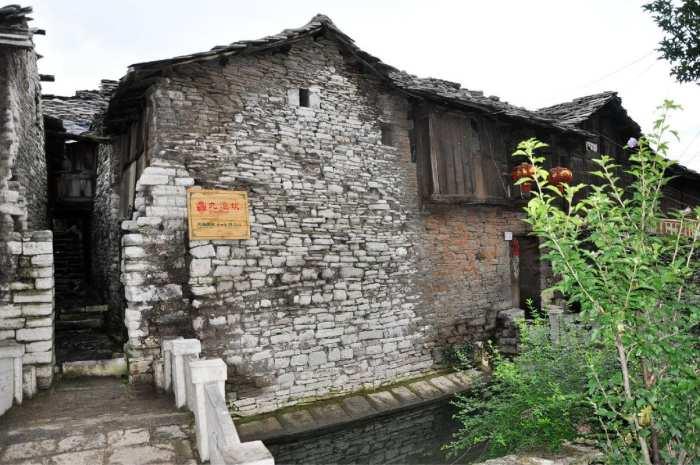
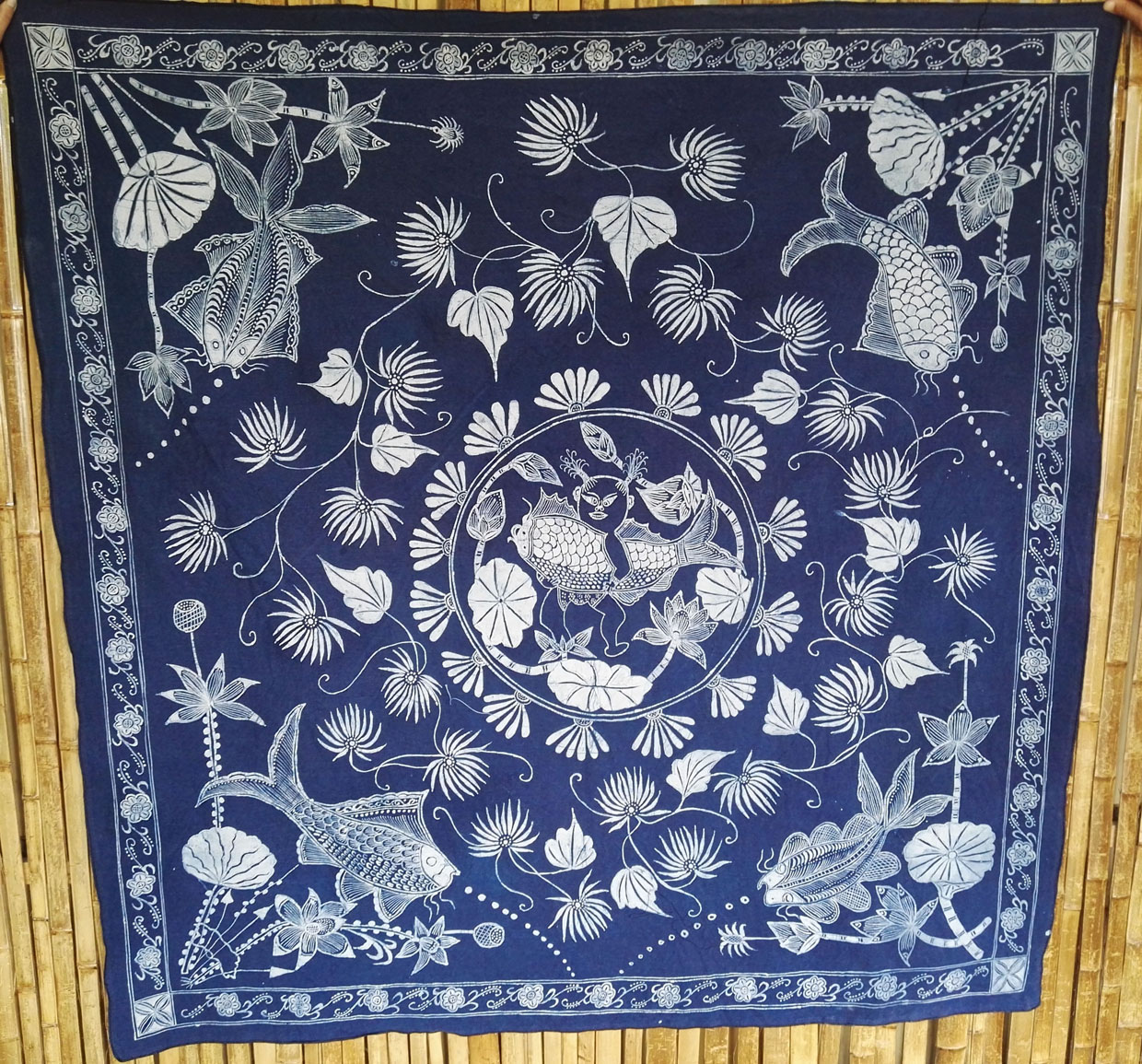
A Buyi village where every house, wall, bridge and lane is built of stone — and where batik is made by hand in almost every courtyard. Women still dye indigo cloth with wax patterns; a panel costs from tens to hundreds of yuan depending on size.
| Admission | ¥40 (reference) |
| Address | Biandan Mountain, Zhenning Buyi-Miao County, Anshun |
| Getting there | Minibus Anshun South – Zhenning (¥9–12), then Zhenning – Dadiqong buses alight at the village (¥5); or taxi from Huangguoshu ¥20–30 |
| Best season | All year |
Six kilometres below the Grand Falls, 30+ m of drop and a dozen rapids — the single biggest single-drop chute is 4 m. Rainy-season rafting through spray and mist is the classic thrill.
A living fossil of Chinese theatre — masked performers in Ming military costume, chanting epic tales of the Yang, Yue and Three Kingdoms generals in a one-drum-one-gong rhythm.
Anshun's grandest Miao festival, every first lunar month: young men blow reed flutes and women dance with silver bells around decorated flower trees — courtship, archery contests and bullfights across 24 flower slopes.
The Buyi "little New Year": blood-flagged fields to keep locusts away, temple rituals, and whole villages picnicking on the hillsides with glutinous rice and water-wine.
Inside the scenic area the choice is thin and pricey; around the entrance, family guesthouses run ¥60–200 (view the room, then negotiate). Since the falls complex fits one long day, staying in Anshun — or returning to Guiyang — widens your options a lot. Our team books any of these for you free of charge.
A mid-to-upper-range villa-style hotel very close to the scenic area, with its own restaurant, pool and lobby Wi-Fi — the comfortable base at the gates.
Directly opposite the ticket hall — the best-value bed inside the scenic area. Computers in the rooms, broadband included, and a friendly owner full of practical advice.
Next to Anshun railway station and the south bus station — practical for train travellers, with singles and doubles at honest prices.
Dozens of private guesthouses around the scenic-area gate, mostly ¥60–200 — inspect the room first, then agree the price. Ask about breakfast and shuttle pickup.
Returning to the provincial capital after a full falls day gives you 699 star-rated Guiyang hotels and the night-market world — an easy 2.5-hour coach ride each way.
157 star-rated hotels in Anshun are listed on ToursChinaTravel, sorted by rating with phones and booking contacts — five-star first.
Anshun's table mixes Guizhou heat with Buyi tradition: changwang noodles in glossy pig-intestine broth, Huajiang dog stew, buckwheat cold noodles with fermented bean curd, and the sweet steamed chongchong cake. If you are heading to the station after the falls, the Anshun snack street is a five-minute walk from the railway forecourt.
Red-broth egg noodles with pig intestines, tender blood tofu and fried pork cubes — the same bowl Guiyang made famous, done with the local hand-rolled noodles.
People drive hundreds of kilometres for this one: fire-scorched dog meat in a minted hotpot, judged the first of its kind in Guizhou — chewy skin, fierce peppers, and soybeans to crunch.
Simple rooms, superb country cooking — the Qingbo fish is firm-fleshed and intensely fresh, served in a rich farmhouse style right beside the scenic area.
Sweet-buckwheat noodles from the Guizhou plateau, sliced or scraped, dressed with fried soybeans, peanuts, chilli oil and Anshun's famous fermented bean curd — cool, savoury, perfect in summer.
Steamed glutinous rice pressed through a tin steamer into rose-sugar-topped cakes, and Anshun's breakfast of crisp fried rice balls in glossy rice porridge — sweet, soft and addictive.
From Guiyang's sour-fish houses to Kaili's night markets — our province-wide food guides link every city's table.
Anshun Huangguoshu Airport (formerly Anshun Airport) is 45 km from the falls and 6 km from Anshun city — with flights from Beijing, Chongqing, Guangzhou, Qingdao, Kunming and Jinan.
Huangguoshu has no station of its own — Anshun Station is the gateway, about 1h10 from Guiyang at ¥15.5.
The cheapest, easiest road access: direct buses from Guiyang's Jinyang station and frequent runs from Anshun's two bus stations.
The three falls sections sit kilometres apart — the ¥50 shuttle-bus pass links them all day, or charter a park taxi for freedom.
Anshun–Huangguoshu is 45 km of expressway (~30 min, ¥20 toll); from Guiyang it's a comfortable 2-hour run. Stone Village, Longgong and Tunbao all fan off this loop.
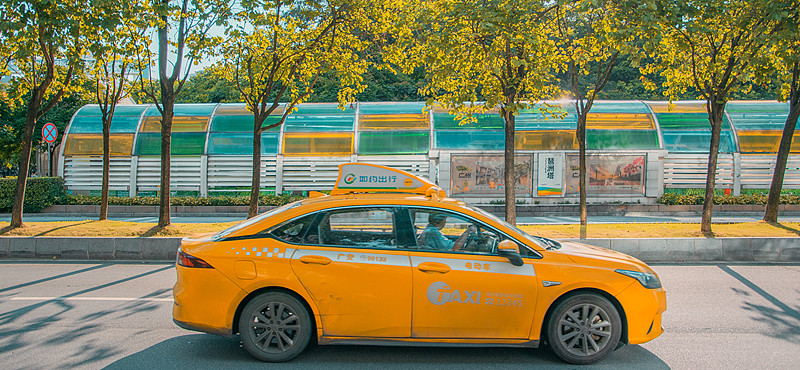
Cheap by city standards: ¥4–6 for the first 3 km by day, ¥10 at night — and ¥20–30 gets you from the falls to Stone Village.
Anshun batik — "the first dye of the East", two millennia of wax-resist indigo work in Miao and Buyi styles; watch it being made at Stone Village and buy panels from tens to hundreds of yuan. Anshun three knives (kitchen, scissors, leather) — a century-old local craft. Bobo sugar from Zhenning, sesame-fragrant and instantly meltable. And carved ground-opera masks for collectors.
At Shitouzhai, buy batik straight from the women at work. At Tianlong Tunbao, pick up opera masks and Ming-style cloth after the ground-opera show. In Anshun city, batik galleries and souvenir shops line the old streets near the station and West Bus Station. An Agricultural Bank ATM stands at the scenic-area visitor centre for cash.
A small clinic stands at the exit of the Grand Falls. For anything serious, head to Anshun: Xixiu District No.1 People's Hospital, 47 Tashan East Road · +86 853 3223 561. Emergencies: dial 120; police 110.
Anshun is 0853 area — phones here begin +86 853. Banks concentrate in Anshun city; the scenic-area visitor centre has an Agricultural Bank ATM. Best advice desk: your guesthouse owner or our team.
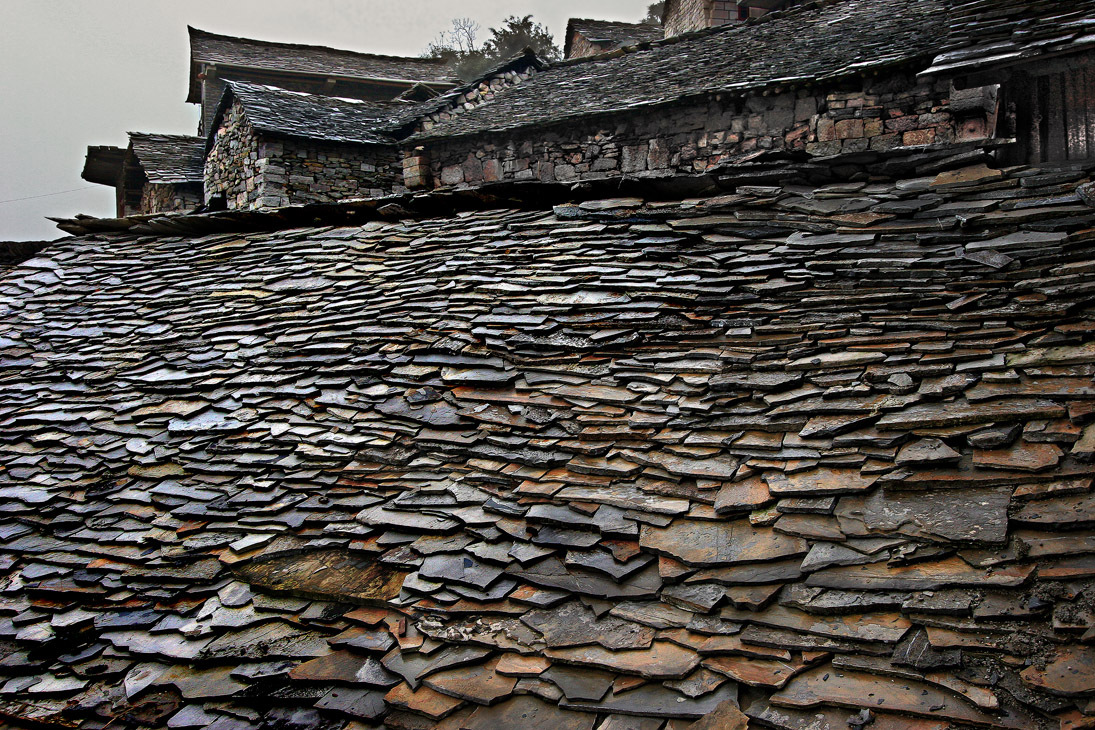
Nine kilometres from the falls: the Buyi kingdom of stone — slate roofs, stone bridges and courtyards where women still draw wax on indigo cloth. Watch the craft, buy a panel, and be back at your hotel for dinner.
More Huangguoshu day tripsAn hour from Anshun: the Ming garrison town of Tianlong — stone fortress houses, people in Ming robes, and a ground-opera show every half hour. On the way back, detour to the Red Cliff Script, China's eight great mystery scripts, etched in iron-red characters on a 100 m cliff since antiquity.
Tianlong Tunbao guideJune–September gives you the falls at full roar and the classic rainbows. In dry winter the Grand Falls shrinks and the Silver Chain can vanish — adjust expectations if you come in the cool season.
The birth-stone path congests badly after 10:00. Start there, reach the Silver Chain falls before tour groups, then take the Grand Falls at leisure.
The Water-Curtain Cave is mist-slick. An umbrella helps, a disposable raincoat is overkill — keep the camera zipped until you're through the windows.
Standard tours stop at Tianxing Lake and miss Tianxing Cave and the Silver Chain falls. The ¥50 shuttle pass makes DIY easy and cheaper than it sounds.
Guizhou passes are full of 180° switchbacks. If you are not a confident mountain driver, charter a car with a local driver instead of renting.
The falls sit in a karst basin at 600–1,500 m in west Guizhou — mid-subtropical, with 1,300+ mm of rain a year and an average 14–16°C. Frost-free all year and mild in every season, it's a genuine escape from both winter and summer heat. The rainy season (May–September) is what feeds the Grand Falls.
Huangguoshu first appears in writing in the Ming-era Guizhou Atlas and Gazetteer (Hongzhi reign), and Xu Xiake — China's great traveller-geographer — described it in 1638 on his way to Yunnan: "ten thousand bolts of white silk hanging across the door... jade crushed into pearls, spray thrown back like smoke." The Tunbao villages beside it carry a different history: Ming garrisons settled by imperial order after 1368, whose descendants still wear Ming clothes and stage the old military opera.
Zhenning is a Buyi-Miao autonomous county: the Buyi majority favour indigo, white and blue, silver bird-and-flower hair ornaments and jade bracelets. Their "June 6" little New Year, the Miao Flower-Tree Festival and the Gelao New-Rice Festival all colour the calendar — and Shitouzhai's batik is one of the most visible of all the crafts of the falls country.
Everything on ToursChinaTravel is bookable through our team by email or WhatsApp. Here's where each part of your Huangguoshu trip lives on the site.
Star-rated sight details — hours, tickets, phones and travel tips for every Guizhou attraction.
Browse Guizhou sights157 star-rated hotels in Anshun, 2,313 across Guizhou — sorted by rating, all bookable by our team.
Book a Guizhou hotelRoutes, airlines and schedules for Anshun Huangguoshu and Guiyang Longdongbao airports.
See China flightsLicensed Guizhou travel agencies with addresses, phones and booking contacts.
Find a Guizhou agencyBatik, tea, chillies and plateau herbs — where each is made and where to buy it.
Browse Guizhou specialtiesGuiyang, Libo, Qiandongnan, Zhenyuan, Dalian and more — city by city, in one place.
Browse all guides