Guilin & Yangshuo: China's Karst Masterpiece — Complete Guide
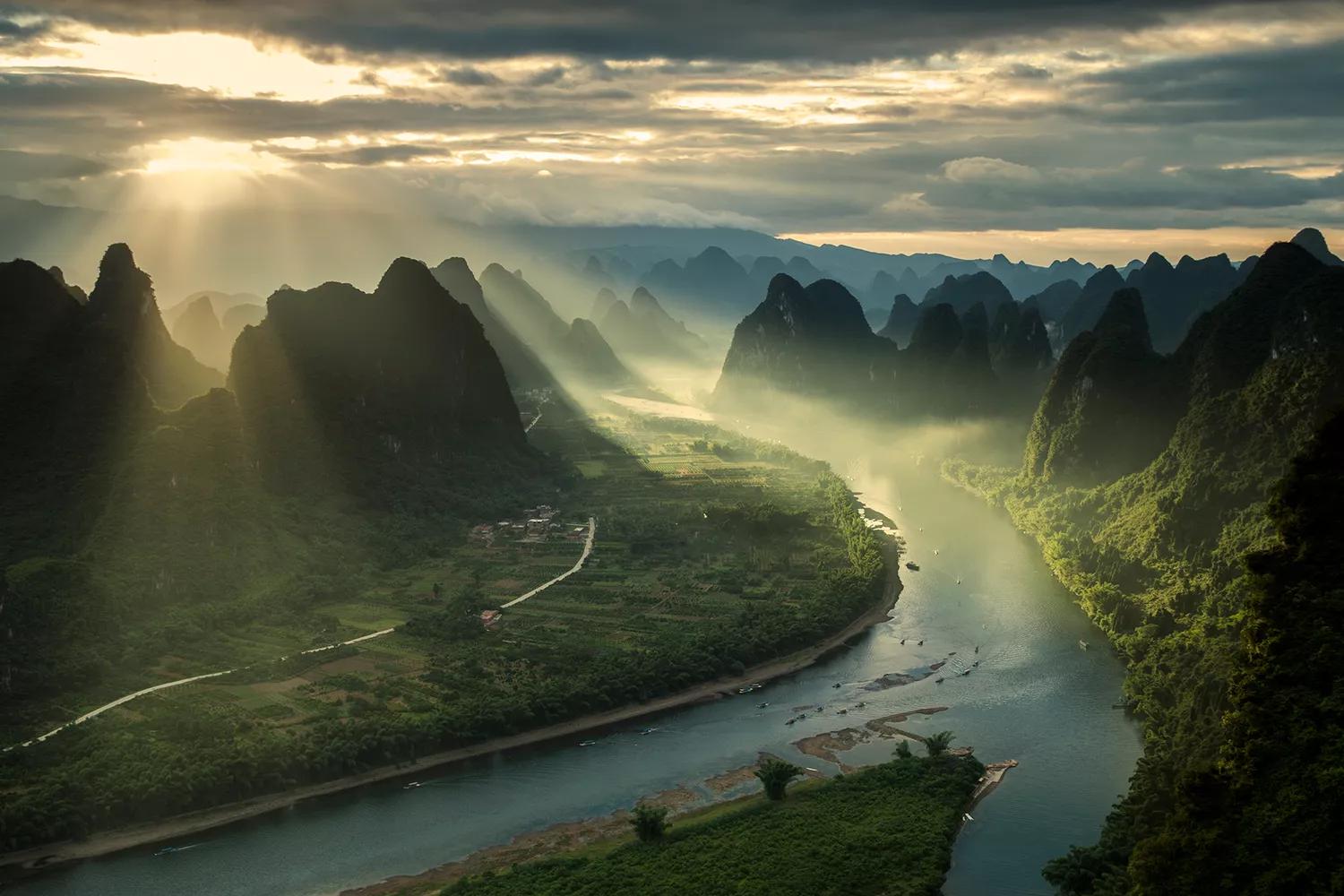
The karst peaks of Guilin and Yangshuo — thousands of conical limestone hills rising from emerald rice paddies and the jade-green Li River — are the image of China that appears on banknotes, ink paintings and a thousand travel posters. They are also, refreshingly, exactly as beautiful as the pictures. This guide covers everything you need to plan 3–5 days in the region: the Li River cruise, the cycling paradise of Yangshuo, the Longji rice terraces, the viewpoints photographers fight over, the caves, the food, and the honest logistics of getting there and around.
Guilin or Yangshuo: Where Should You Base Yourself?
The classic answer is both. Guilin (population 5 million including the metro area) is the transport hub — international airport, high-speed rail station, and the launch point for the Li River cruise. It has the city sights: Elephant Trunk Hill, the Reed Flute Cave, the Twin Pagodas. Yangshuo, 65 km downstream, is the countryside dream — karst peaks all around, the Yulong River running through town, and cycling, rafting, rock climbing and hiking on every side.
The ideal split: one night in Guilin for arrival and the cruise, then two to four nights in Yangshuo for the countryside. Day-trippers from Guilin to Yangshuo exist but miss the point — the town's magic happens in the early morning and evening, when the tour buses are gone. If you prefer comfort over atmosphere, base in Guilin and take a Yangshuo day trip; if you want the experience, sleep in Yangshuo.
The Li River Cruise: Booking, Route and What to Expect
The Li River cruise from Guilin to Yangshuo is the region's signature experience — four hours drifting past the famous peaks: the Painted Mountain with its 'nine horses' rock face, the Xingping scenery printed on the 20-yuan banknote, and dozens of hills named for their shapes — the Camel, the Snail, the Crown. Boats depart from Zhujiang Wharf, about 40 minutes south of central Guilin.
Practical details: the standard four-star boat costs roughly 400–500 RMB including lunch and transfers; book through your hotel or a tour platform, ideally a day ahead. Boats run morning departures, and the journey ends at Yangshuo's waterfront, where your hotel can pick you up. Upgrade to a small VIP boat for a quieter deck if the group boats feel crowded. Alternative: the popular bamboo-raft (bamboo pole raft) trips on the river's upper reaches — a gentler, wetter ride through the most beautiful scenery, bookable at the Yangdi and Yulong areas.
A photographer's tip: the classic 20-yuan viewpoint at Xingping is best at sunrise, when the river is still and the peaks layered in mist — arrive before 07:00 and you will have the banknote view almost to yourself.
Yangshuo by Bicycle: The Best Day of the Trip
Yangshuo's countryside is a cycling paradise — flat valley floors, sealed lanes between rice paddies, and karst peaks rising like islands from the green. Rent an electric bike (60–100 RMB/day) or a mountain bike (30–50 RMB/day) and follow the classic route: west out of town along the Yulong River, across its low stone bridges (the famous Yulong Bridge), through Moon Hill village, and back through the paddy lanes south of town.
The best ride is the Yulong River loop: from Yangshuo, ride west to the Yulong Bridge, cross the river, then follow the eastern bank south past Moon Hill — the arch-shaped hill that is Yangshuo's other icon — and return through the village lanes. Allow four to five hours with stops. Evening option: the Impression Sanjie Liu show, the giant outdoor performance by director Zhang Yimou on the Li River itself, with hundreds of performers, floating stages and the karst peaks as backdrop — book tickets in advance; the show runs most evenings.
Xianggong Hill and the Viewpoints That Define the Region
The photograph of the Li River you have seen everywhere — the great bend with five distinct peaks — is taken from Xianggong Hill, a low limestone hill above Xingping village, about 25 minutes by car or e-bike from Yangshuo. It is a 20-minute climb to the top, and the sunrise view over the river bend is the region's defining image. Arrive 40 minutes before sunrise; bring a tripod; the entrance costs 20 RMB.
Other viewpoints worth the effort: the Yulong Bridge at golden hour (free, and almost empty), Moon Hill itself (climb the 800 steps for the arch framed by peaks), and the rooftop terraces of the riverside hotels in Xingping. For the most atmospheric option, take a dawn bamboo raft on the Yulong River — the mist rises off the water and the peaks float like islands in the clouds.
Longji Rice Terraces: The Mountain Detour Worth Every Minute
Two hours northwest of Guilin, the Longji (Dragon's Backbone) Rice Terraces climb the mountainsides in terraced arcs built over 700 years by Zhuang and Yao farmers. The two main viewpoints — Ping'an Village and the Dazhai/Jinkeng terraces — both deliver the panorama that made Longji famous: tier after tier of flooded rice paddies catching the light, with the Yao villages of wooden stilt houses clinging to the slopes.
Best seasons: April–June, when the terraces are flooded and mirror the sky; September–October, when the ripening rice turns the slopes gold. The best experience is an overnight stay in a terrace-side guesthouse — the sunset and sunrise over the paddies, with the mountain villages silent, are among China's great travel moments. Reach Longji by private car or public bus from Guilin (about 2.5 hours); entrance is 80 RMB, and the climb to the viewpoints is steep but manageable with walking poles.
The Caves: Reed Flute Cave and Beyond
Karst terrain means caves, and Guilin's are exceptional. Reed Flute Cave, 5 km northwest of the city, is the classic — a 240-metre-long gallery of stalactites and stalagmites lit in theatrical colours, discovered by locals fleeing a 1960s flood. It is touristy, yes, and still worth 90 minutes: the 'Crystal Palace' chamber alone, a cavern the size of a football field, justifies the visit.
For a more adventurous option, the Silver Cave near Yangshuo is longer and less crowded, and the Gudong and Crown caves offer underground river boat rides through lit limestone canyons. Cave temperatures stay around 18–20°C year-round — a bonus on hot summer days.
Eating in Guilin and Yangshuo
Guilin's food is defined by the river and the mountains. The local hero is Guilin rice noodles (guilin mifen) — silky rice noodles in a rich broth with pickled beans, peanuts and chilli, sold at breakfast stalls everywhere for 5–8 RMB; the classic morning ritual is a bowl at a streetside shop, eaten standing like the locals. Yangshuo adds beer fish (pijiu yu) — river fish braised in beer with tomatoes and peppers, the town's signature dish — and the beer duck, snake soup and mountain vegetable stir-fries that come with the rural setting.
Where to eat: Yangshuo's West Street is the tourist strip (good for a first night), but the lanes behind it and the villages outside town hold the real food. Ask your guesthouse host where they eat — the answer is almost always better than any guidebook recommendation.
Practical Planning: Getting There, Getting Around, Best Time
Getting there: Guilin Liangjiang International Airport connects with Beijing, Shanghai, Chengdu, Guangzhou and dozens of Chinese cities; high-speed rail reaches Guilin from Guangzhou (3 hours), Shenzhen, Nanning, Changsha and Guiyang. From the airport, the airport shuttle or Didi reach the city centre in 40 minutes. Getting around: between Guilin and Yangshuo, take the Li River cruise (4 hours) or the high-speed rail shuttle bus (1.5 hours); within Yangshuo, use e-bikes, bicycles, Didi and the local shuttle buses.
| Season | Weather | Pros | Notes |
|---|---|---|---|
| Apr–Jun | Mild, rainy spells | Green paddies, flooded terraces, fewer crowds | Pack a light raincoat |
| Jul–Aug | Hot, humid | River activities at their best | Summer thunderstorms; book early |
| Sep–Oct | Best weather | Gold terraces, clear skies, harvest | Golden Week Oct 1–7 crowded |
| Nov–Mar | Cool, dry | Low prices, misty peaks | Cold evenings; bring layers |
A final word: the Li River's water level varies by season — the cruise runs year-round, but in dry winter months the scenery is still lovely, just less dramatic. For hotels, our Guilin Hotels and Yangshuo pages list verified properties in both towns, and the Guilin Travel Guide covers the city's sights in full detail.
Three-Day Guilin-Yangshuo Plan
- Day 1 — Arrive Guilin: Elephant Trunk Hill, Reed Flute Cave, evening at the Twin Pagodas
- Day 2 — Li River cruise to Yangshuo, settle in, sunset at the Yulong Bridge, Impression Sanjie Liu at night
- Day 3 — E-bike the Yulong River loop, Xianggong Hill sunrise or Moon Hill, depart or extend with Longji
With five days, add the Longji terraces overnight and a full day of village cycling. The region rewards exactly that — time, two wheels and an early alarm.
Beyond the Classics: Xingping, the Yulong Valley and Lesser-Known Villages
The Guilin region rewards going one level deeper. Xingping village, 30 minutes by car or shuttle from Yangshuo, is the photographer's base — the 20-yuan viewpoint, the ancient streets, and the Li River's most beautiful bend. Stay a night at a riverside guesthouse and you get the sunrise without the crowd: the classic banknote view at first light, the river mist, the fishermen (with their cormorants, now largely for show) poling past. The Old Town of Xingping is compact and real — rice noodle shops, a century-old theatre, and lanes that end abruptly at the water.
South of Yangshuo, the countryside opens into a grid of villages connected by narrow lanes perfect for e-bike exploration: Jiuxian village with its ancient gates, the Gaotian village paddy fields, and the Fuli ancient town with its brush-and-ink shops. The 'Ten-Mile Gallery' road between Yangshuo and the Yulong Bridge is the touristy highlight reel (Moon Hill, the Big Banyan Tree, Butterfly Spring) — worth riding through, less worth stopping at the ticketed sights. The real magic is off that road, one lane deeper, where farmers still work the paddies and the karst peaks seem to surround you from every angle.
Adventure Yangshuo: Climbing, Rafting and Caves
Yangshuo is China's adventure-sports capital, and the karst cliffs are world-famous climbing. The main crags — Moon Hill, the Wine Bottle, the Swiss and the Bamboo areas — offer everything from beginner sport routes to multipitch epics; local guiding companies (Yangshuo Climbing, and the climbing houses on West Street's edge) run half-day courses from about 300–500 RMB including gear, and the quality is excellent. Rock climbing in Yangshuo is beginner-friendly: the limestone is featured and grippy, the routes are bolted, and the scenery is the best belay view in the world.
On the water, bamboo rafting is the other essential. The most authentic experience is the Yulong River rafting — the shallow, slow river west of town where 'bamboo' rafts (now mostly fibreglass replicas painted to look traditional) are poled by local boatmen through the countryside; the full section from Yulong Bridge to Gongnong Bridge takes about 2.5 hours and costs roughly 180–220 RMB per raft. The Li River's rafting sections near Yangdi are wilder and the scenery grander. Both require a life jacket and some patience — the boatmen often negotiate extra tips for singing or fishing demonstrations, which is fine if you want the show.
Guilin City Sights: What Is Worth Your Time
Guilin city deserves one to two days around the cruise. Elephant Trunk Hill (19 RMB), the city's symbol — a rock arch over the Li River shaped like an elephant drinking — is the classic photo and a pleasant riverside walk; the best view is from the opposite bank or from a river cruise. The Reed Flute Cave (90 RMB) is the show cave. The Sun and Moon Twin Pagodas (free outside, lit beautifully at night) sit on Fir Lake in the city centre. The Jingjiang Princes' City (the Ming palace compound, with the Solitary Beauty Peak climb) is the most underrated — 100 RMB includes the wall walk and the peak's panorama over the old city.
Guilin's other gift is its riverfront: the Li River walking path from the Elephant Hill to the Twin Pagodas, the night market along Zhengyang Street, and the Guilin Art Museum's collection of Li River landscape paintings — the region has inspired painters for a millennium, and seeing their work before seeing the real thing deepens both.
Practical Tips: Booking, Packing and Avoiding the Traps
- Book the Li River cruise, Impression Sanjie Liu and Longji terrace guesthouses at least 3–7 days ahead in peak season
- Carry small cash for villages, rafts and street food — Alipay works widely but not universally in the countryside
- Pack: sun hat, insect repellent (June–September), light rain jacket, walking sandals for rafts, and a tripod for sunrise viewpoints
- The classic scams are soft: overpriced 'tea ceremonies', 'calligraphy' sales and fake jade in Yangshuo's tourist shops — buy nothing at guided stops
- Taxi meters: insist on the meter in Guilin city; use Didi where possible
- Best photo windows: Xianggong Hill sunrise, Yulong Bridge golden hour, Li River from the cruise deck at 10:00–11:00 when the light is high and clear
The Guilin-Yangshuo region is compact, forgiving and photogenic to a fault. Three days gives you the icons; five gives you the secret lanes, the terraces and the sunrises. Either way, the karst peaks will follow you home in your camera roll — and onto your return-trip list. Our Guilin Travel Guide and the Yangshuo hotels directory have the full booking details.
Yangshuo's Best Season, One Day at a Time
A day in Yangshuo, done properly: start before 08:00 with the Yulong Bridge or Xianggong Hill (the light is soft, the rafts are still, and the peaks wear their mist), ride the e-bike loop through the paddies by mid-morning, lunch on beer fish in a village restaurant, spend the afternoon swimming at the Yulong River's swimming holes (locals will show you — the water is clean and the banks are sandy), and finish with sunset at the Yulong Bridge or the observation deck at the East Street end, followed by a night-market dinner and, if the season allows, the Impression Sanjie Liu show. This is the day the region is famous for, and it costs almost nothing beyond the bike rental.
Rainy days are not wasted days: the caves (Silver Cave, Gudong) are dry, the tea houses and pottery studios in the villages take bookings, and the misty rain on the karst is its own aesthetic — the Chinese landscape painters were painting exactly this weather. The only real weather hazard is the summer thunderstorm's effect on rafting (the river rises and rafts pause); check with the raft companies in the morning.
Yangshuo Hotels: Where to Wake Up in the Karst
Where you sleep in Yangshuo shapes the whole experience. The town centre (West Street and the riverside) is the lively base — guesthouses, boutique hotels and the night market at your door, five minutes from the river and the bike rentals; the riverside stretch south of town holds the region's dreamiest options — paddy-view hotels with infinity pools facing the karst, bookable through the major platforms and worth every yuan of the premium; and the villages across the Yulong River (Yulong Bridge village, the Moon Hill area) offer the quiet country stay — farmhouse guesthouses, terrace views and breakfasts of rice noodles and local eggs. For the Longji terraces, the terrace-side guesthouses (Ping'an or Dazhai) are the essential overnight, with balconies over the paddies and sunrise at your window.
Practical notes: book the riverside and paddy-view properties 2–4 weeks ahead in season; the town's budget guesthouses fill on weekends; and the village stays often include breakfast and e-bike rental — ask when booking. Every level of our Yangshuo hotels directory has verified options with honest reviews.
Guilin Region in One Glance: A Quick Reference
For planning at a glance: Guilin city is the transport hub (airport, HSR), Yangshuo is the countryside base, Xingping is the photographer's village, and Longji is the mountain detour. Distances: Guilin–Yangshuo 65 km (cruise 4 h, bus 1.5 h, car 1 h); Yangshuo–Xingping 25 km (30 min); Guilin–Longji 100 km (2.5 h). Money: 1,200–2,000 RMB per person covers 3 days including hotels, meals, transport and the main tickets — among China's best-value regions. Language: English is thin outside the tourist core; the translation app and Chinese-character addresses are essential. Safety: the region is safe; the main cautions are the traffic (scooters everywhere) and the tourist-shop pricing. And the one booking rule: the Li River cruise, the terraces' guesthouses and the Impression show all need 3–7 days' lead time in season.
Responsible Travel in the Karst Countryside
The Guilin-Yangshuo region's beauty is its economy, and a few easy habits keep it beautiful. The rice terraces of Longji are the clearest case: the farmers still work the paddies because visitors come to see them, so staying in a village guesthouse and buying the local rice wine supports the very landscape you photograph. The Li River's water quality is directly tied to riverside development — choose operators who follow the river rules, take your litter out, and skip the disposable raft covers where offered. And the villages welcome respectful visitors: ask before photographing people, buy the local crafts at fair prices, and remember that the 'authentic' village experience you came for depends on the villages staying liveable for the people who live there.
Guilin-Yangshuo Travel Insurance and Safety Notes
The region is among China's safest, with the routine cautions: the scooters on the town streets (look both ways twice), the rafting life jackets (wear them — the river is shallow but the rocks are real), the steep terrace steps (walking poles help), and the sun (a hat and sunscreen matter on the open river and the terraces). Travel insurance is strongly advised — it covers the rafting, climbing and hiking that define the region, and the hospitals in Guilin and Yangshuo are well equipped for the minor incidents that make up most travel medicine. Carry your passport copy, keep the hotel's address in Chinese, and register with your embassy's travel app — the standard toolkit anywhere.
Frequently Asked Questions
How many days do you need in Guilin and Yangshuo?
Three days covers the essentials (Li River cruise, Yangshuo cycling, one viewpoint); four to five days is ideal and lets you add the Longji rice terraces and a slower pace. The region is small enough to base yourself in Yangshuo for most of the stay.
Is the Li River cruise worth it?
Yes — the four-hour cruise from Guilin to Yangshuo is the classic way to see the karst scenery and includes lunch. Book a day ahead; the small VIP boats are quieter. Photographers and budget travelers often prefer the cheaper bamboo-raft trips on the upper river.
What is the best time to visit Guilin and Yangshuo?
September–October is the sweet spot: clear skies, golden rice terraces and comfortable temperatures. April–June is also excellent with greener scenery. Avoid the National Day Golden Week (Oct 1–7) and consider the hot, humid summer only if you enjoy river activities.
Can I do Guilin and Yangshuo as a day trip?
Technically yes from Guilin, but you will miss the best parts — the early-morning and evening atmosphere of Yangshuo, the cycling and the sunrises. Stay at least one night in Yangshuo; most travelers prefer two to three.
How do I get from Guilin to Yangshuo?
The Li River cruise (4 hours, most scenic), the high-speed rail shuttle bus (1.5 hours from Guilin's rail station), or a private car (about 1 hour). The cruise drops you at Yangshuo's waterfront with your luggage on board.
Plan this trip with our China team
Tickets, hotels, trains and local arrangements — free booking help, reply within hours.