>
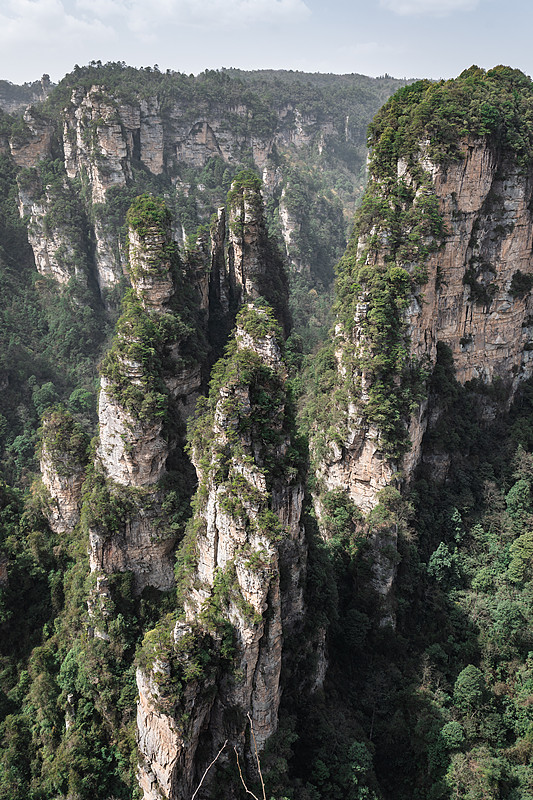
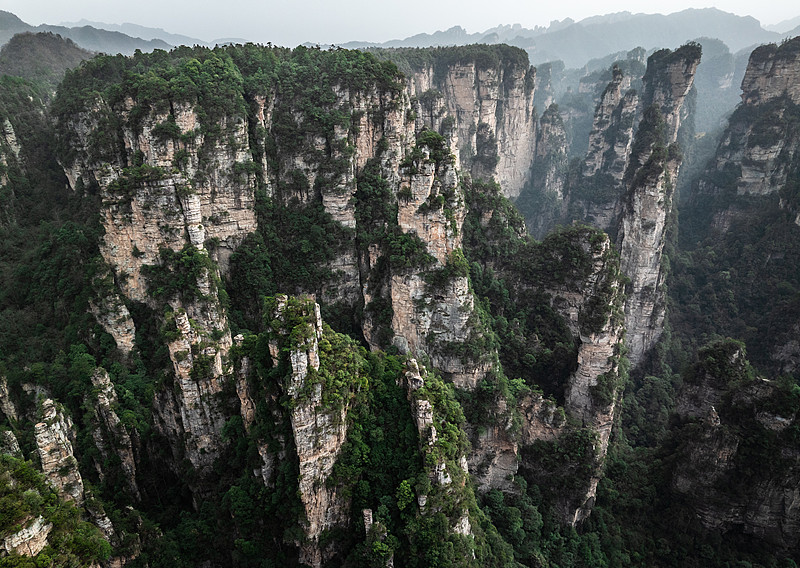
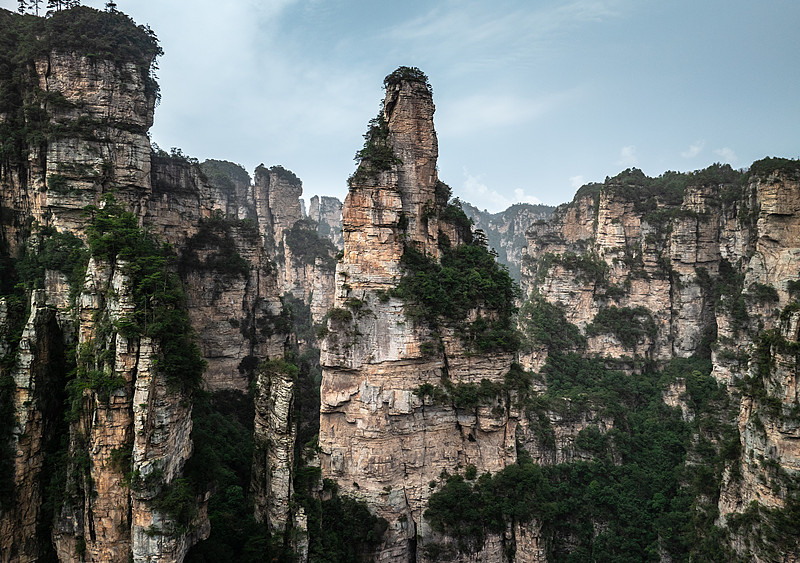
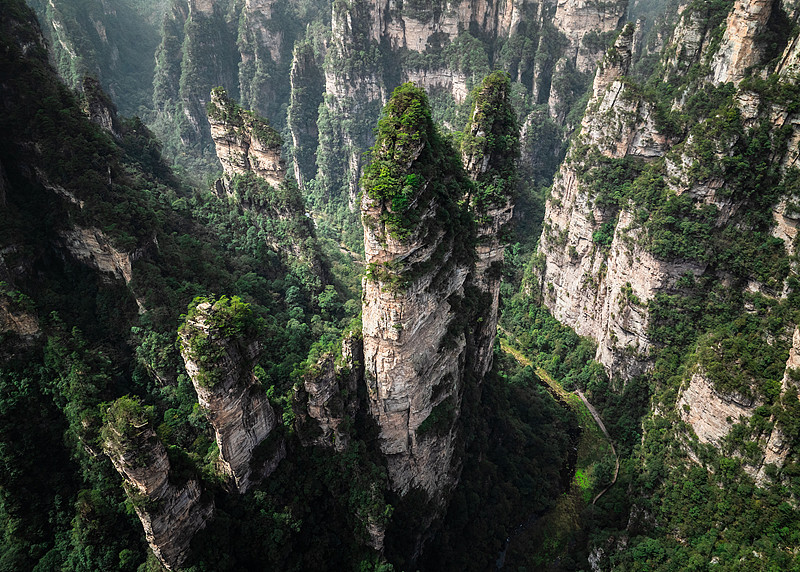
3,000 quartz-sandstone pillars rising from the forest — the landscape that inspired James Cameron's Pandora. Avatar hype aside, this is simply the strangest, most vertical scenery in China: the Avatar Hallelujah Mountain, the glass skywalk, and the deepest forest park in Hunan.
The pillar that launched a thousand posters — the Avatar Mountain viewpoint in Yuanjiajie is the park's great selfie spot.
A 60 m glass ledge bolted to the cliff of Tianmen Mountain, 1,430 m up — with the Heaven's Gate arch below it, China's most dramatic walk.
The greenest walk in the park — a 7.5 km valley trail under the pillars, with macaques on the path and waterfalls in season.
The 'Son of Heaven' summit — the cable car lifts you 1,200 m for the classic view of 3,000 pillars in the cloud sea.
The 326 m glass elevator built into the cliff — up in 88 seconds to the Yuanjiajie plateau, the park's engineering marvel.
Asia's grandest karst cave — 13 km of chambers, underground rivers and the biggest stalactite hall in China.
3,000 quartz-sandstone columns up to 300 m tall — the only forest of its kind on earth, listed by UNESCO.
The high flat world above the pillars — Avatar Mountain, the First Bridge Under Heaven and the elevator up the cliff.
The mountain with a hole in it — the 131.5 m Heaven's Gate arch, the glass skywalk and the 99-bend mountain road.
Golden Whip Stream and the valleys below the pillars — the green, monkey-populated underside of the park.
April–June is green and lush; September–October the clearest views with the least rain; December–February brings occasional snow on the pillars and few crowds. July–August is hot, busy and wet — the mist can hide the peaks entirely.
Three days is the sweet spot: one for the National Forest Park (Golden Whip + Yuanjiajie), one for Tianzi and the canyon, one for Tianmen Mountain. Two days can cover the essentials with planning; four adds Yellow Dragon Cave and the Grand Canyon glass bridge.
The official Avatar Hallelujah Mountain is the pillar viewed from Yuanjiajie — reached by the Bailong Elevator or the park shuttles. The name dates from the 2010 Avatar publicity campaign; the pillar itself is one of hundreds.
The Tianmen skywalk is 60 m long, 1.5 m wide, bolted to a 1,430 m cliff — yes, it is scary, and yes, everyone does it. Shoe covers are provided; phones go in the pocket, not the hand.
The classic budget choice is Dingxiangrong village inside the park (sunrise at Daguantai). Otherwise Wulingyuan town (the park gate) is the standard base, and Zhangjiajie city suits Tianmen and the airport. Park-entry tickets are valid multiple days — keep them.
Yes — email [email protected] or message us on WhatsApp. We arrange park tickets, hotels, guides and the Tianmen cable car, free of charge.
The full sweep — the forest park, Tianzi, the canyon and Tianmen. View the plan →
Golden Whip Stream on foot, then the Bailong Elevator up to Yuanjiajie — Avatar Mountain and the First Bridge — sleep in Dingxiangrong village.
Dawn at Daguantai, morning on Tianzi Mountain and the Ten-Mile Gallery, afternoon the Yangjiajie trails before the night show in Wulingyuan.
Tianmen Mountain: the 99-bend road, the skywalk and Heaven's Gate — cable car down to the city, evening flight or train onward.
Adds Yellow Dragon Cave and the Grand Canyon glass bridge. View the plan →
Golden Whip Stream and Yuanjiajie by elevator — the green day among the pillars.
Tianzi Mountain, Ten-Mile Gallery and Yangjiajie; night at the Xiangxi performance in Wulingyuan.
Yellow Dragon Cave in the morning and the Zhangjiajie Grand Canyon glass bridge in the afternoon.
Tianmen Mountain — the skywalk and Heaven's Gate — before the evening onward connection.
All plans are bookable end-to-end by our team — see the full day-by-day Zhangjiajie itineraries hub, or the day-trip pages for single-day options.
The original pillar forest — 3,000 quartz-sandstone columns up to 300 m tall in a subtropical rainforest, China's first national forest park (1982) and a UNESCO site.
View details →The high plateau of the park — Avatar Hallelujah Mountain, the First Bridge Under Heaven, and the 326 m Bailong Elevator built into the cliff.
View details →The 'Son of Heaven' summit — cable car up 1,200 m to the classic 3,000-pillars-in-cloud view; the Ten-Mile Gallery and the imperial-palace rock forms are below.
View details →The 7.5 km valley trail under the pillars — the greenest walk in the park, with macaques, waterfalls and the golden-whip rock that gives it its name.
View details →The mountain with a hole in it — the 131.5 m Heaven's Gate arch, the 60 m glass skywalk, the 99-bend road and the world's longest passenger cable car (7,455 m).
View details →Asia's grandest karst cave — 13 km of passages, underground rivers and the 40-storey-high Dragon Palace hall, 30 min from Wulingyuan.
View details →More in the region on the Hunan attractions page.
The Tujia-Miao song-and-dance spectacular in Wulingyuan — 90 minutes of fire, drums and the mountain people's legends, the best show ticket in town.
The Zhangjiajie Grand Canyon glass bridge (¥138+bridge fee) — 430 m long and 300 m high, the world's longest and highest glass span.
The Tujia celebrate their new year on lunar 29 December — bonfires, folk songs and the hand-swinging dance at the village halls.
The classic photographer's hour — sunrise over the pillar sea from the Daguantai platform, reached from Dingxiangrong village.
Every hotel below is bookable by our team; browse the full Hunan hotels directory.
The budget classic — guesthouses inside the forest park, steps from Daguantai sunrise. From ¥150; book ahead in high season.
The standard base at the park gate — from five-star towers to family inns, all with shuttle access to the entrance. From ¥250.
The airport and Tianmen base — bigger, cheaper, and 30 min by road from the park gates. From ¥200.
The classic city address, handy for Tianmen cable car station. From ¥350.
The comfortable end of the gate — pools, buffets and organised park logistics. From ¥500.
Zhangjiajie's signature — pork, beef and chicken stewed together with chili in one pot; the 'three pots' of the Tujia mountain table.
Hanging-smoked pork and bacon — the mountain pantry staple, sliced thin and stir-fried with green peppers.
Sweet-potato noodles in broth — the quick breakfast of the park towns.
Stream fish steamed whole, and the sticky-rice dishes of the Tujia table.
The Tujia herbal — bark, tea and supplements from the mountain plantations.
Pillar-shaped stone ornaments and Tujia carved boxes from the Wulingyuan market.
Hand-stitched pouches, belts and wall hangings in the mountain style.
Local green and brick teas of the region — the light, grassy 'Jiangya' is the classic buy.
Full local-product guides live on the Hunan specialties page.
Direct flights link Beijing, Shanghai, Guangzhou, Shenzhen, Chengdu, Xi'an and Kunming; the airport is 30 min from the city and 40 from Wulingyuan. Airport buses and taxis (¥80–100) cover both.
The HSR (opened 2019) links Changsha (2 h), Guangzhou (5.5 h) and Beijing (via change); the old Zhangjiajie station is downtown for classic trains. Wulingyuan is a 30 min taxi from the HSR station.
Coaches run from Changsha (4 h), Fenghuang (4 h), Wuhan and Changde to both the city and Wulingyuan — the classic budget approach.
Free shuttle buses loop the park's four gates and main stations (Golden Whip, Bailong, Tianzi cable car) — the park is huge; plan your gate in and out.
Regular buses and taxis shuttle the 30 km between Zhangjiajie city and Wulingyuan gate (¥20 bus, ¥100 taxi) — allow an hour in traffic.
The park roads are restricted to shuttles; Tianmen's 99-bend road takes private cars up to the mid-station only — use the cable car for the summit.
The world's longest glass bridge over the canyon — 430 m of glass, 300 m of air, with the river trail below.
Asia's grandest karst cave — underground rivers, the Dragon Palace hall and a boat ride in the dark.
The 7,455 m cable car, the glass skywalk and the Heaven's Gate arch — the city's iconic mountain.
The border town of Tuojiang — stilted houses, river lanterns and the night scene of the 'Phoenix', 4 h by bus or 2 h by train.
¥228 covers four days and all four gates — sleep in the park one night and you can split the circuits without re-buying.
The pillars live in cloud — if rain clears the view, wait an hour at the nearest pavilion; the classic photo needs the mist, not blue sky.
The Bailong Elevator queues badly (1–2 h) in season — go at opening or late afternoon, and pair it with the Golden Whip walk to time the crowds.
The park's monkeys grab bags, phones and sunglasses — keep food out of sight and snacks in a zipped pack.
Free covers are provided for the glass walk — and phones go in pockets; the wind at 1,430 m is not a suggestion.
Zhangjiajie's pillars are quartz sandstone — 380-million-year-old beach and river sediment, hardened and then carved by frost and water into 3,000 columns up to 300 m tall. The park's 130 km² of subtropical forest shelters macaques, giant salamanders and 500 species of plants.
Named for the Zhang family village of the Tujia people, the area was opened to forestry in the 1950s and became China's first national forest park in 1982, a UNESCO site in 1992. The global fame arrived in 2010 when the film Avatar's floating mountains drew crowds to the renamed 'Hallelujah Mountain' — the pillar was promptly adopted by the park's marketing as the inspiration for Pandora.
The Tujia, the region's majority people, built the stilted houses, sang the love songs and invented the hand-swinging dance that still closes the evening shows — the culture under the scenery.
Everything on ToursChinaTravel is bookable through our team by email or WhatsApp. Here's where each part of your Zhangjiajie trip lives on the site.
Star-rated sight details — hours, tickets, phones and tips for every Hunan attraction.
Browse Hunan sightsStar-rated hotels across Hunan — sorted by rating, all bookable by our team.
Book a Hunan hotelRoutes, airlines and schedules for flights and rail to Zhangjiajie.
See China flightsLocal products, crafts and foods of Hunan — where to find each one.
Browse Hunan specialtiesLicensed agencies with addresses, phones and booking contacts.
Find a Hunan agencyMore city and region guides across China, including the Hunan guide.
Browse all guides