>
A granite wonderland in northeastern Jiangxi — 1,600 years of Taoist history, 14-billion-year-old rock spires, the Goddess Peak and the Giant Python, and a cloud sea that rivals Huangshan's. UNESCO listed it in 2008 as 'a rare combination of scenic and aesthetic value'.
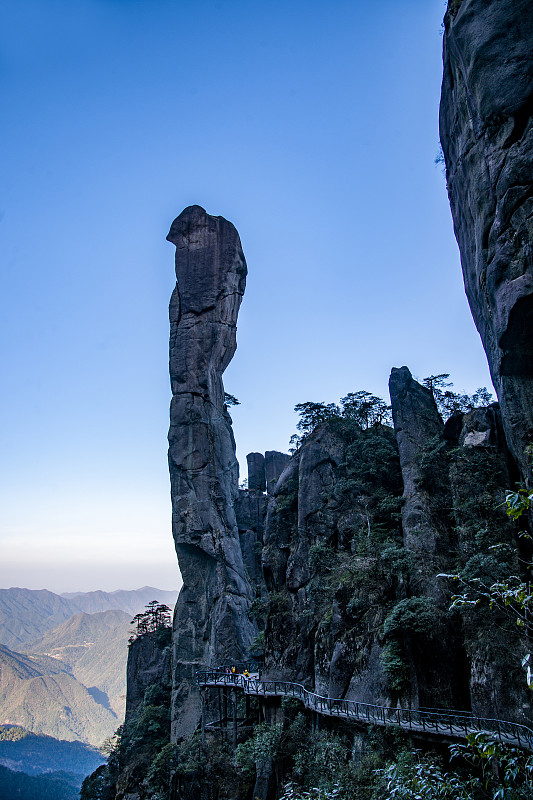
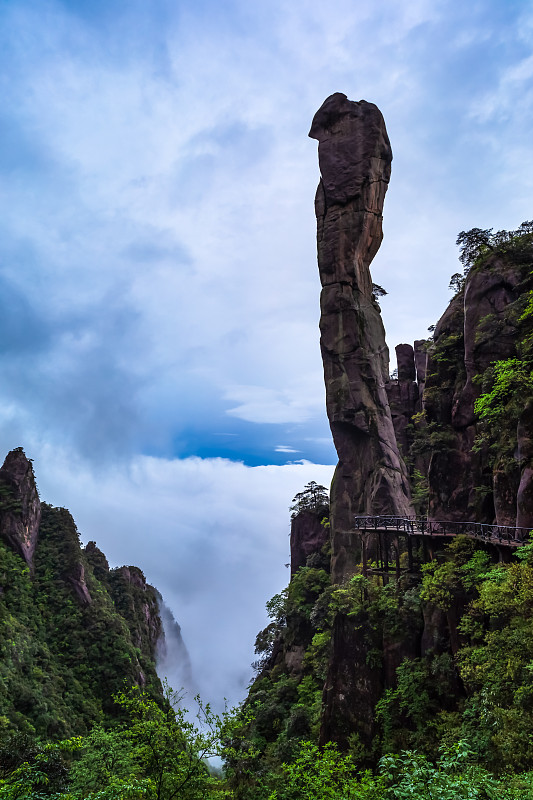
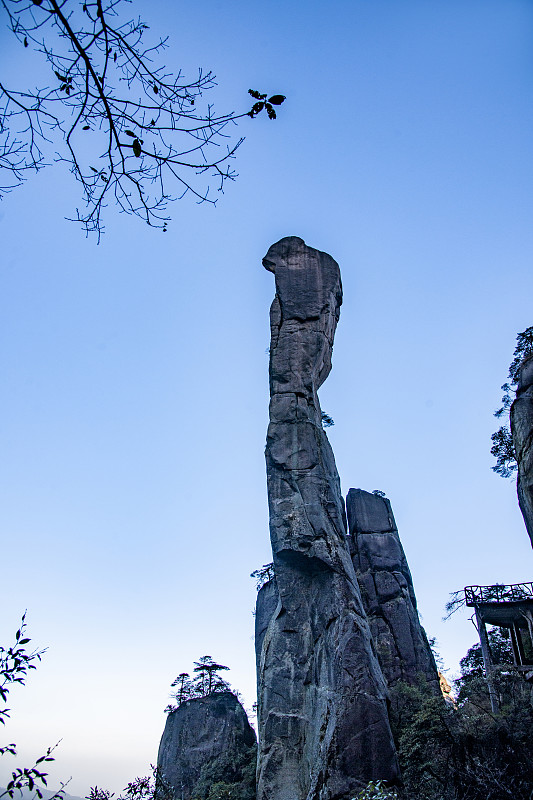
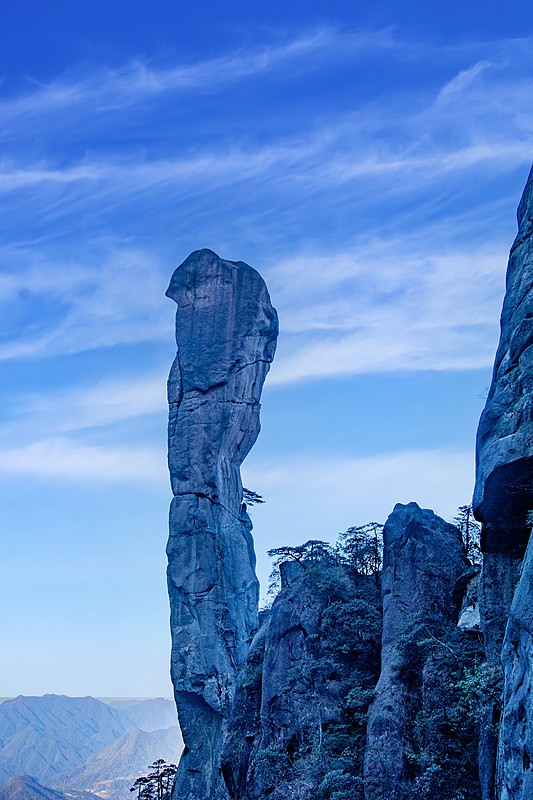
A 128 m granite spire that rears like a snake's head above the forest — one of the two emblems of Sanqingshan, best seen from the Southern Garden circuit.
The mountain's other emblem — a weathered rock profile of a woman with flowing hair, whom Taoists call the 'Goddess of Spring' (Sichun).
A 3 km cliff-hugging boardwalk on the west face — granite walls on one side, cloud sea on the other, the most thrilling path in the park.
At 1,819.9 m the highest of the three pure peaks — the dawn view over the cloud sea is the mountain's great prize.
The Taoist heart of the mountain, rebuilt in the Ming — a complex of halls and grottoes dedicated to the Three Pure Ones, 1,600 years of incense.
The finest granite-garden circuit — a 2–3 hour loop of strange rock forms, pines and rhododendrons.
14 billion years of erosion left a forest of stone pillars — the Giant Python, the Goddess and a thousand unnamed spires.
Named for the Three Pure Ones and cultivated by Taoists since the Jin dynasty — temples, grottoes and carved inscriptions.
A suspended boardwalk over the cloud sea — 'the most beautiful cliff path in eastern China'.
Autumn skies and May rhododendron blooms frame the classic views.
May brings the rhododendron bloom and fresh green; September–October the clearest air and best cloud-sea odds. Summer is green and crowded, winter brings snow and closures on the high peaks. Rain clears fast — the cloud sea you want is usually born of a wet morning.
One long day covers the classic circuit (Southern Garden – West Coast – Sanqing Palace) by cable car. Two days adds Jade Capital sunrise and the full East Coast loop — the mountain rewards the overnight stay.
The East cable car (Jinsha) reaches the main plateau fastest and is the standard entry; the South cable car (Waishuangxi) serves the Southern Garden approach. Round trip is ¥125; buy both legs in advance in peak season.
Visitors often call it 'Little Huangshan' — the granite spires, pines and cloud sea are genuinely similar, but Sanqingshan is quieter, lower and cheaper, with a stronger Taoist character. Many travellers pair it with Huangshan or Wuyuan.
Night on the mountain means the plateau hotels by the East cable car (simple but scarce); otherwise base in Shangrao city or Yushan county, 1–1.5 h from the gates. Peak-season mountain beds must be booked days ahead.
Yes — email [email protected] or message us on WhatsApp. We arrange hotels, cable-car tickets, guides and transport from Shangrao, free of charge.
The essential circuit: Southern Garden, West Coast Skywalk, Sanqing Palace and the two emblems. View the plan →
East cable car up to the plateau, the Southern Garden loop (Giant Python, Goddess Peak, rhododendrons), the West Coast Skywalk to Sanqing Palace, then down past the sunset point to the cable car.
Adds Jade Capital dawn and the full East Coast — the complete mountain. View the plan →
Up the East cable car, the Southern Garden and the Giant Python, then the West Coast to Sanqing Palace before dusk — sleep at the plateau hotel.
Pre-dawn climb to Jade Capital Peak (1,819.9 m) for sunrise over the cloud sea, then the East Coast loop and the cable car down by noon.
All plans are bookable end-to-end by our team — see the full day-by-day Sanqingshan itineraries hub, or the day-trip pages for single-day options.
The 128 m granite spire that made Sanqingshan famous — a 'snake' rearing from the forest, best photographed from the Southern Garden viewing platform.
View details →The weathered rock profile of a woman with flowing hair — the 'Goddess of Spring', Taoist patron of the mountain and its most-photographed face.
View details →A 3 km boardwalk bolted to the vertical west face — sheer granite on one side, cloud sea below the other, the park's signature walk.
View details →The summit at 1,819.9 m — the sunrise spot over the cloud sea, and the highest of the Three Pure peaks. A stiff 1–1.5 h climb from the plateau.
View details →The Taoist heart of the mountain — halls, grottoes and 1,600 years of incense to the Three Pure Ones, rebuilt in the Ming dynasty.
View details →The strangest-rock garden on the mountain — a 2–3 h loop of spires, pines and rhododendron groves below the two emblems.
View details →More in the region on the Jiangxi attractions page.
The pre-dawn climb to 1,819.9 m for the cloud-sea sunrise — the mountain's signature ritual, best in autumn's clear air.
May turns the Southern Garden and the plateau pink — the mountain's own festival week celebrates the bloom with photo walks.
Sanqing Palace and the mountain's grottoes still receive Taoist pilgrims — a quiet morning at the palace is the culture beneath the scenery.
The classic pursuit: October's stable weather gives the cleanest cloud seas from the West Coast and the peaks.
Every hotel below is bookable by our team; browse the full Jiangxi hotels directory.
The few hotels by the East cable car station — simple rooms, thin walls, unbeatable position for dawn. From ¥400; book days ahead in season.
Family hotels at the East gate village below the mountain — the standard night-before base. From ¥180.
The HSR hub 70 km away — the most comfortable and cheapest base, with morning buses to both gates. From ¥150.
Halfway between Shangrao and the South gate — convenient for the Waishuangxi cable car. From ¥120.
For the longer trip: Wuyuan's villages are 1.5–2 h away — pair the mountain with the 'most beautiful countryside in China' in one itinerary.
The regional specialty — duck slow-braised in soy and chili, served at every Shangrao table.
Fern tips, stone fungus and bamboo shoots from the slopes — the honest lunch on the plateau.
The sweet souvenir of the region — brittle sesame bars, sold at the cable-car villages.
For the crossover trip: Wuyuan's clear-broth fish and stuffed tofu are a short bus ride away.
Mountain honey from the May bloom — the classic Shangrao gift.
Small sculptures in the local granite, sold at the gates.
Incense and printed talismans from Sanqing Palace — the cultural souvenir.
The regional sweet — light, cheap and packable.
Full local-product guides live on the Jiangxi specialties page.
Shangrao HSR station links Hangzhou (2 h), Nanchang (1 h), Shanghai (3 h) and Wuyuan (40 min). Tourist buses and taxis cover the 70 km to the mountain gates; classic trains stop at Yushan for the South gate.
Tourist coaches run from Shangrao bus station and Yushan county to both cable-car gates (about 1–1.5 h). In season, direct coaches also arrive from Wuyuan and Huangshan.
The small airport (25 km south of Shangrao city) serves Beijing, Guangzhou, Shenzhen, Chengdu and Haikou; Nanchang Changbei is the big alternative, 2.5 h by HSR.
The park's own buses connect the two cable-car stations on the ring road — the full loop takes about an hour and links the East and South approaches.
East (Jinsha) and South (Waishuangxi) cable cars climb in 10–15 min — round trip ¥125, one-way ¥70. Peak-season queues reach 1–2 h; buy early.
The ring road serves both gates with good parking; winter ice can close the high road. From Shangrao allow 1.5 h.
The 'most beautiful countryside in China' — rapeseed terraces, white-and-black villages and rainbow bridges, 40 min by HSR from Shangrao.
The Xin River waterfront, the Shangrao museum and the sesame-candy markets of the HSR city.
The quiet county at the South gate — local breakfasts, the old street and the departure point for the Waishuangxi cable car.
Riverside towns below the mountain, guizhou-style snacks and the terraced countryside of the Xin valley.
Peak-season queues at both gates can hit two hours — take the first shuttle at 07:30 or, better, sleep at the plateau and ride down early.
The plateau is 1,400–1,800 m — 5–8°C colder than Shangrao, with sudden wind and fog. A fleece plus rain shell works May–October; winter needs real cold-weather gear.
The best odds are dawn to 10:00, especially after rain — be on the West Coast or a peak by first light.
The Southern Garden and West Coast circuits are one-way in parts — follow the arrows to avoid doubling back; the plateau map at the cable car exit is your friend.
Sanqingshan is one leg of the great northeast-Jiangxi loop — Wuyuan is 40 min by HSR, Huangshan a half-day onward.
Sanqingshan rises to 1,819.9 m in the Huaiyu mountains of northeastern Jiangxi. Its granite — among the oldest exposed rock in China, around 1.4 billion years old — was sculpted into pillars and spires by frost and water, forming the 'granite forest' the world now lists as UNESCO World Heritage.
Named for the Taoist Three Pure Ones (Yuqing, Shangqing, Taiqing), the mountain was cultivated from the Jin dynasty; Ge Hong practised alchemy here, and the Tang and Song emperors patronised its temples. Sanqing Palace, rebuilt in 1453, remains the ritual heart, and Taoist pilgrims still climb the old stone stairways.
Inscribed in 2008, Sanqingshan was praised for its 'exceptional natural beauty' and 'striking array of granite pillars and peaks' — one of only a handful of Chinese World Heritage sites listed primarily for scenery.
Everything on ToursChinaTravel is bookable through our team by email or WhatsApp. Here's where each part of your Sanqingshan trip lives on the site.
Star-rated sight details — hours, tickets, phones and tips for every Jiangxi attraction.
Browse Jiangxi sightsStar-rated hotels across Jiangxi — sorted by rating, all bookable by our team.
Book a Jiangxi hotelRoutes, airlines and schedules for flights and rail to Sanqingshan.
See China flightsLocal products, crafts and foods of Jiangxi — where to find each one.
Browse Jiangxi specialtiesLicensed agencies with addresses, phones and booking contacts.
Find a Jiangxi agencyMore city and region guides across China, including the Jiangxi guide.
Browse all guides