>
A cool green massif above the Yangtze plain — waterfalls, cloud seas, English villas and the summer retreat where Chiang Kai-shek and Mao Zedong both worked. Su Shi's line — 'I cannot see the true face of Lushan, only because I am on the mountain' — still says it best.
Li Bai's 'silver river falling from the ninth heaven' — a 155 m three-tier cascade, best after rain, reached by cable car and a long staircase.
The highest point (1,474 m) — on clear days you can see the Yangtze, the Poyang Lake and, it is said, far-off Hanyang across the river.
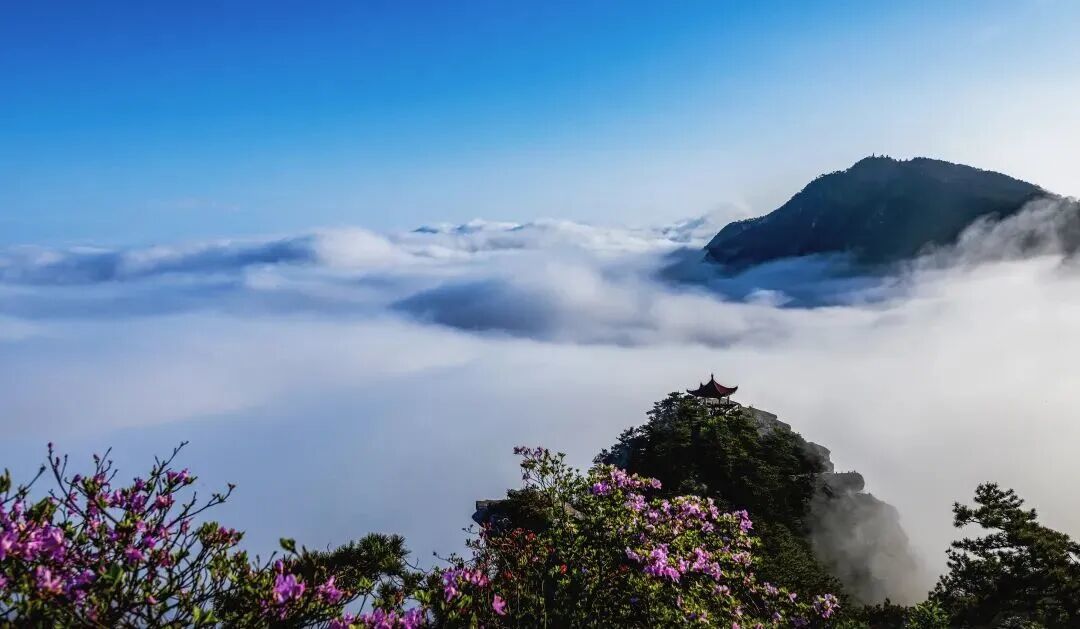
The mountain's signature moment — cloud boiling up from the valley, the peaks turning into islands, best in spring and autumn mornings.
1,000+ English, American and Swiss villas from the treaty-port era — the summer capital of the Yangtze valley.
72.5°C radon-rich springs at the foot of the mountain — the biggest natural hot-spring field in China, at Tianmu, Xihai and Longwan.
Five granite ridges like the profile of five elders — the second summit view, and the classic spot for the Poyang Lake panorama.
The Three-Step Waterfall and dozens more — Li Bai's poetry made Lushan the waterfall capital of Chinese verse.
'I cannot see the true face of Lushan' — the mountain wears its fog like a crown, and the best views are born of it.
Guling town was the summer seat of the Chiang regime and the missionary world — a mountain full of old stone houses and forested lanes.
Radon-rich mineral springs that local lore — and the compendium Ben Cao Gang Mu — have credited for centuries.
Summer (May–September) is the classic season — Lushan was chosen as a summer resort precisely because it stays 5–7°C cooler than the plain. Spring and autumn give the clearest cloud seas; winter snow is beautiful but icy. October is ideal for red leaves on the Five Old Men Peak.
Two days covers the classics — Guling, the Three-Step Waterfall and one peak sunrise. Three days adds the Five Old Men, the east side and an afternoon in the hot springs. Fit visitors can do the essence in one long day from Jiujiang.
Moderate. Guling town sits at 1,164 m on a plateau, so much of the sightseeing is gentle. The Three-Step Waterfall involves about 1,400 steps down and up (or a cable car back); the peaks are proper climbs of 1–2 hours each.
Most visitors sleep in Guling town on the plateau — hotels, guesthouses and the historic villas are all here, and the buses fan out from the town centre. Budget travellers can base in Jiujiang city and day-trip up.
Yes — Jiujiang station (classic rail) and Jiujiang West (HSR) are about 40 minutes from the mountain gate; Lushan station on the HSR is closer. Buses climb from both stations and from Nanchang about 1.5 h by HSR plus shuttle.
Yes — email [email protected] or message us on WhatsApp. We arrange hotels in Guling, waterfall tickets, guides and transport, free of charge.
The plateau loop, the cloud sea and Li Bai's waterfall — the essence in two days. View the plan →
Arrive at Guling, walk the Huajing path and Brocade Valley to the Immortal's Cave, then sunset over the Poyang plain from the Dragon's Head Cliff.
Dawn at Hanyang Gap, morning at the Five Old Men Peak or Three-Step Waterfall (cable car up, stairs down), afternoon bus back to Jiujiang.
Adds the east side, the villas and the hot springs at the foot of the mountain. View the plan →
Guling town and its villas — the former residence of Chiang Kai-shek and the American School — then Brocade Valley and the Immortal's Cave.
Hanyang Gap dawn, the Three-Step Waterfall by cable car, afternoon free in Guling with a visit to the Lushan Museum (the old temple of a princess).
Down the mountain to the Tianmu hot-spring resort — a morning soak, then the bus to Jiujiang or Nanchang.
All plans are bookable end-to-end by our team — see the full day-by-day Lushan itineraries hub, or the day-trip pages for single-day options.
The 155 m cascade Li Bai compared to a silver river — three distinct drops over mossy granite. Best after rain; reached by cable car (¥50) plus about 700 steps, or the full stair descent from the plateau.
View details →The summit of Lushan at 1,474 m — the highest viewpoint in the range, with the Yangtze to the west and the Poyang Lake to the east.
View details →The famous cloud-sea viewpoint where the valley fills with mist — the 'true face of Lushan' of the poem, best at dawn in spring and autumn.
View details →Five connected granite ridges, each a different silhouette — the classic Poyang Lake view and one of Lushan's great dawn spots.
View details →The 1,164 m plateau resort — 1,000+ historic villas, the Huajing garden, the Immortal's Cave and the old lanes of a mountain capital that once hosted the world's press.
View details →China's biggest radon-rich hot-spring field at 72.5°C, facing Hanyang Peak across the valley — the classic reward at the end of a mountain trip.
View details →More in the region on the Jiangxi attractions page.
The mountain has been a summer resort since 1895 — most Julys bring open-air concerts in the Guling square, continuing the old treaty-port habit of culture at altitude.
The mountain's great pursuit — dawn at Hanyang Gap, dusk at the Dragon's Head Cliff, and the mist rolling over Brocade Valley at any hour.
The famous 'cloud and mist' tea of Lushan is picked on the plateau slopes in spring — a cup at a Guling teahouse is the local rite of passage.
Below the mountain, Jiujiang's Yangtze waterfront — the Poyang Lake mouth, the Xunyang Pavilion and Gan Tang Lake — makes a gentle night out.
Every hotel below is bookable by our team; browse the full Jiangxi hotels directory.
The long-standing plateau hotel near the town centre — the classic base for dawn trips and cloud-sea walks. From ¥320.
Many of the historic stone villas now sleep guests — the former summer houses of missionaries and officials, with fireplaces and forest gardens. From ¥380.
The former guesthouse of state visitors at the heart of Guling — old-world rooms and a grand garden. From ¥500.
Base in Jiujiang for the cheapest beds — HSR and classic stations both run buses up the mountain; the Yangtze waterfront is walkable. From ¥150.
Hotel-plus-springs at the mountain's south foot — soak all evening, climb in the morning. From ¥400 including spa access.
Grown on the wet cliffs — the plateau specialty, served in soups and stir-fries at every Guling restaurant.
Fresh fish from the great lake at the mountain's foot — the classic Jiangxi treatment is a clear broth or red-braised with chili.
Fried tofu stuffed with minced pork — a Jiujiang comfort classic found all over the plateau.
The mountain's green tea — light, nutty and mist-grown; buy from the Guling teahouses rather than the tour stalls.
The 'cloud-and-mist' green tea of the plateau — the classic souvenir, sold loose in paper packets.
Dried cliff-grown fungus, light to pack and prized for soups.
Carved stones from the mountain's famous landscape rock — paperweights and small sculptures.
Salted and smoked fish from the lake region, a Jiujiang pantry staple.
Full local-product guides live on the Jiangxi specialties page.
Lushan station (on the Nanchang–Jiujiang HSR, ~40 min from the mountain gate) is the most convenient; Jiujiang West and the classic Jiujiang station also run direct shuttle buses up. From Nanchang: HSR 1.5 h.
Public buses climb from Jiujiang station and the Jiujiang coach terminal to Guling (about 1 h, ¥15). From Nanchang, change at Jiujiang or take the direct tourist coach in season.
The nearest airports are Jiujiang Lushan Airport (domestic flights) and Nanchang Changbei (the big regional hub, 2 h by HSR+bus). Taxis from Jiujiang airport to the mountain about ¥80.
Green tourist buses loop Guling and the main sights (¥70 all-day pass; single rides ¥10) — the plateau is served but walking is the real joy.
The Three-Step Waterfall cable car saves the steepest descent; the Tramway (Lushan cable car) links the north gate to Guling in 7 minutes (¥40 one way).
Private cars are restricted above the gates — leave the car at the north or south gate car parks and use the shuttle. Winter ice closes the summit road some days.
The Yangtze waterfront, the Xunyang Pavilion and the lake mouth where the Poyang meets the river — the city below the mountain.
A soak in China's largest radon hot-spring field at the mountain's foot, facing Hanyang Peak across the valley.
The cliff-top temple at the mouth of the Poyang Lake that gave the region its name — bells, grottoes and river views.
For the longer stay: the lake-town circuit of the Poyang region, where the great lake's receding water leaves winter grassland famous for migratory cranes.
The plateau is cool and wet — 5–10°C below the plain, with sudden fog and rain. A light jacket works all summer; winter needs serious warmth.
The classic sight is born of cool mornings — be at Hanyang Gap or the Dragon's Head Cliff by first light, before the sun burns the mist away.
The Three-Step descent is 1,400+ steps — take the cable car down and walk back up, or vice versa, and keep energy for the plateau.
Summer is the resort season — plateau rooms fill with heat-escapees from the plain. Book two weeks ahead in August.
Buy the ¥160 scenic-area ticket at official gates or the official app — one ticket covers the plateau; the waterfall cable car and tram are extra.
Lushan rises abruptly from the Yangtze–Poyang plain to 1,474 m — a block of granite and sedimentary rock 25 km long, its plateau a cool green island above the summer heat. The subtropical monsoon climate makes it one of the wettest, mistiest famous mountains in China.
A religious mountain since the Eastern Jin (4th century), Lushan gathered temples, academies and hermits for a millennium — Bai Juyi's grass cottage, Zhu Xi's White Deer Grotto Academy and Li Bai's waterfalls all live in its verse. In 1895 the missionary Edward Little began the Guling summer resort; in 1927 Chiang Kai-shek made it a summer capital, and in 1959 and 1970 Mao Zedong held the famous Lushan conferences here.
Su Shi's poem of 1084 — written after being lost in the fog — became the mountain's permanent motto: the true face of Lushan can only be seen from outside. It is, fittingly, the most quoted line in Chinese travel writing.
Everything on ToursChinaTravel is bookable through our team by email or WhatsApp. Here's where each part of your Lushan trip lives on the site.
Star-rated sight details — hours, tickets, phones and tips for every Jiangxi attraction.
Browse Jiangxi sightsStar-rated hotels across Jiangxi — sorted by rating, all bookable by our team.
Book a Jiangxi hotelLocal products, crafts and foods of Jiangxi — where to find each one.
Browse Jiangxi specialtiesLicensed agencies with addresses, phones and booking contacts.
Find a Jiangxi agencyMore city and region guides across China, including the Jiangxi guide.
Browse all guides