>
The city of the Longmen Grottoes and the peony — thirteen dynasties ruled from this bend of the Luo River, and the imperial legacy is still carved into the cliffs: 100,000 Buddhist statues, China's oldest monastery, and every April a city-wide sea of peonies.
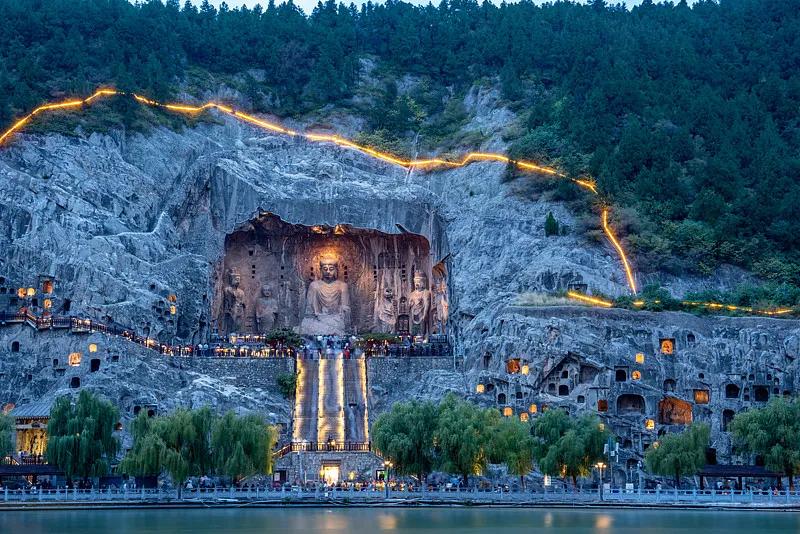
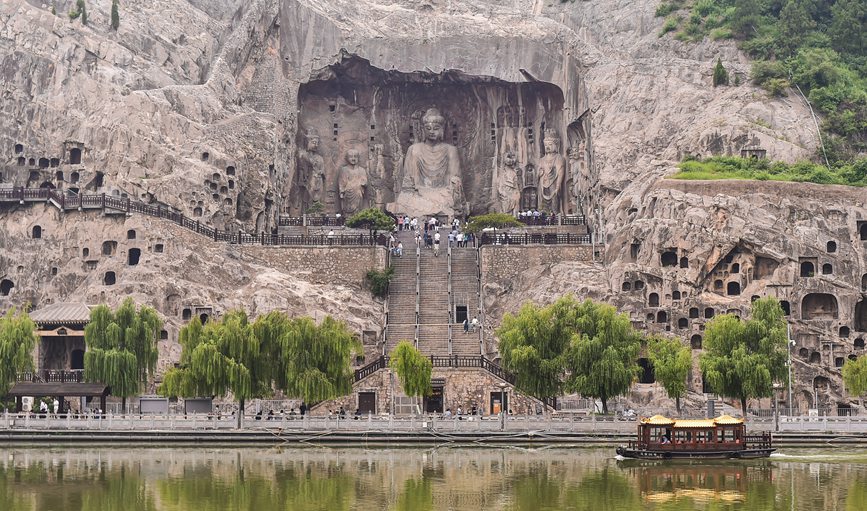
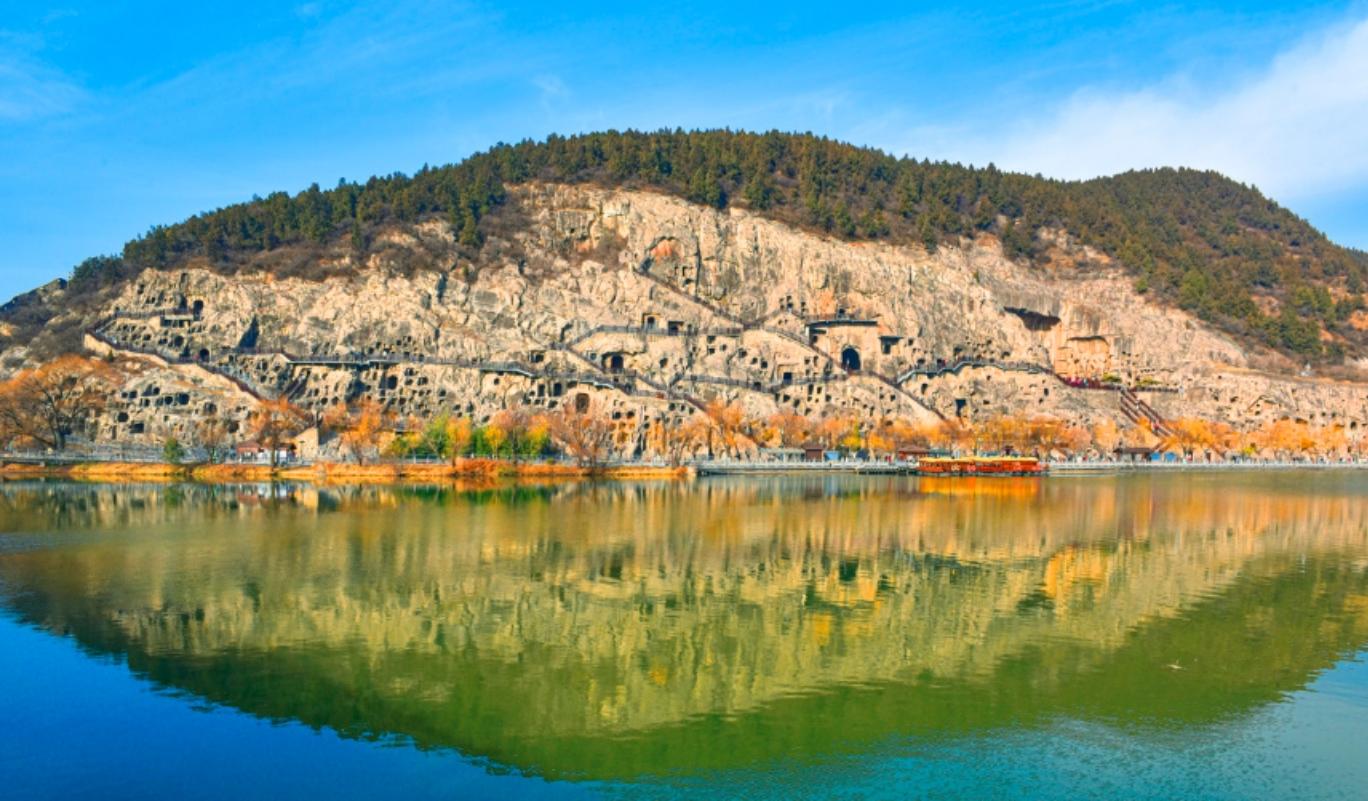
China's grandest open-air sculpture gallery — 2,345 niches and 100,000 statues cut into the cliffs over 400 years, crowned by the 17 m Vairocana Buddha.
China's first Buddhist monastery, founded in 68 AD when two Indian monks arrived on white horses — the birthplace of Chinese Buddhism.
The forest tomb of Guan Yu, the warrior-god of the Three Kingdoms — 800 ancient cypresses around the general's head burial mound.
Ming-era streets, the restored Li Jingmen gate and the water-street night market — the living 'Old City' of the imperial capital.
The national flower city's great month — a million peonies across Wangcheng Park and the National Peony Garden, in every colour but blue.
The Tianzi Jialiu Museum displays a full Zhou-dynasty imperial chariot-and-six-horses burial — the largest such find in China.
Longmen is the high point of Chinese stone carving — a cliff-face museum the Tang court funded for a century.
White Horse Temple's original two monks and their sutras began two millennia of Chinese Buddhism.
Every April Luoyang turns into a flower city — 'national beauty and heavenly fragrance' is the old phrase for the peony.
Thirteen dynasties left palaces, tombs and temple foundations under the modern streets — the deepest history of any Chinese city.
April is the peony month — Wangcheng Park, the National Peony Garden and the streets fill with flowers for about three weeks. Spring and autumn are otherwise the sweetest seasons; summer is very hot and the grottoes get crowded. Winter is quiet, cold and free of queues.
Two days covers the essential Luoyang — Longmen, White Horse Temple and the old town. Three days adds Guanlin, the Tianzi Jialiu Museum and a Shaolin Temple day trip; four stretches to the nearby 'Shangri-la of the Central Plains' sights and the Yellow River.
Yes — the grottoes take about 2.5–3 hours on the main trail (west bank out, bridge over, east bank back). Start at 8:00 opening to beat the tour groups, and add the night session in season (until 22:00) for the illuminated statues.
It is about 80 km away in Dengfeng — a day trip by bus or taxi. Alternatively, many visitors pair Luoyang with the Shaolin Temple and the Songshan mountains over 2–3 days.
The classic is 'Luoyang water banquet' (shuixi) — a 24-course soup-based feast served in bowls; plus the lamb soup, beef soup and noodle dishes of the old town's morning markets, and peony pastry as the sweet souvenir.
Yes — email [email protected] or message us on WhatsApp. Our team arranges hotels, Longmen tickets, guides and the Shaolin day trip, free of charge.
The imperial essentials — grottoes, the first monastery, the old town and the peony park. View the plan →
Morning at Longmen Grottoes (west bank out, bridge back), lunch of Luoyang lamb soup, afternoon Guanlin and the Tianzi Jialiu Museum, evening in the old town by Li Jingmen.
White Horse Temple in the morning, then Wangcheng Park and the peony gardens (April), before the HSR back to Zhengzhou.
Adds the cradle of kung fu — the Shaolin Temple and the Songshan mountains. View the plan →
Longmen Grottoes and the east-bank temples, afternoon Guanlin and the museum, old town at night.
White Horse Temple, then the Peony Garden (in season) and the Luoyang Museum's Han-dynasty treasures.
Day trip to the Shaolin Temple in Dengfeng — the pagoda forest, the monks' martial arts show and a climb up Songshan.
All plans are bookable end-to-end by our team — see the full day-by-day Luoyang itineraries hub, or the day-trip pages for single-day options.
The greatest open-air Buddhist sculpture gallery in China — 2,345 niches, 100,000 statues and 2,800 inscriptions carved 493–1127 AD into the cliffs of the Yi River, led by the 17 m Vairocana Buddha of the Fengxian Temple.
View details →China's first Buddhist monastery, founded 68 AD when Emperor Ming sent envoys west and they returned with two Indian monks and sutras on white horses — the cradle of Chinese Buddhism, with the original pagoda and courtyards.
View details →The tomb forest of Guan Yu — the Three Kingdoms general deified as the God of War — with 800 cypresses and the head burial mound; the great shrine of loyalty in Chinese culture.
View details →The Ming-era old city behind the restored Li Jingmen gate — cross-street shops, the water-street night market and the evening lanterns make it the friendliest place in Luoyang.
View details →The 800,000 m² imperial garden park — in April it hosts the peony festival with 300+ varieties; year-round it is a pleasant lake-and-pavilion escape.
View details →The 2002 excavation of a full Western Zhou imperial burial — six horses, chariots and 28 riders in the original pit, the largest 'son-of-heaven' chariot find in China.
View details →More in the region on the Henan attractions page.
From early April the city celebrates the national flower — Wangcheng Park, the National Peony Garden and the International Peony Garden fill with 300+ varieties for about three weeks.
The cradle of Chinese martial arts at Dengfeng — the pagoda forest, the monks' demonstrations at 11:00/15:00 and the Songshan trails make a classic day trip.
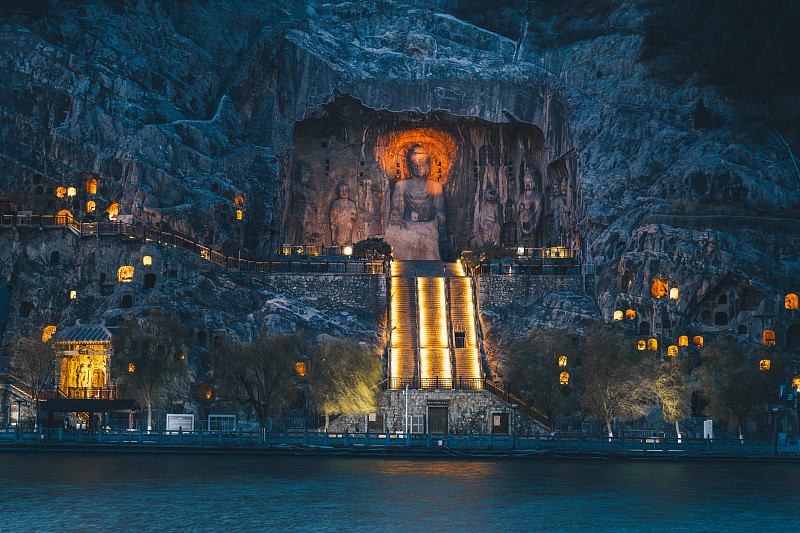
In high season the grottoes stay open until 22:00 with the Vairocana Buddha floodlit — the most atmospheric way to see the statues.
The lamb-soup and noodle breakfast streets inside Li Jingmen — follow the locals' bowls from 6:30 and eat like the imperial capital.
Every hotel below is bookable by our team; browse the full Henan hotels directory.
The grand classic near Wangcheng Park — the peony city's traditional address since the 1950s. From ¥400.
A modern tower beside the peony gardens and the museum district. From ¥500.
Courtyard inns inside the Ming walls by Li Jingmen — the most atmospheric beds in the city, steps from the night market. From ¥180.
Reliable mid-range on Zhongzhou Road, handy for the metro and the airport bus. From ¥350.
Simple family hotels near the monastery for the earliest start — popular with pilgrims. From ¥120.
The imperial feast — 24 soup-based courses served in succession, from the 'peony swallow vegetable' opener to the sweet finale. The old town's Zhen Butong and Laoji are the classic houses.
Luoyang's great breakfast — lamb and offal boiled overnight in a clear broth, eaten with oil-splashed chili and flatbread.
The morning soup trinity — beef soup, and the famous 'not tofu' tofu soup made from mung-bean skins, served by 9:00 in the old town.
The flower-shaped sweet made of bean paste and pastry — the souvenir every visitor takes home, sold all along Li Jingmen.
The 'meat in a bun' of the Central Plains — stewed pork and chili in a crisp sesame flatbread, the fastest and cheapest good meal in town.
The flower city's classic gifts — boxed pastry and dried peony petals for tea.
The Tang-dynasty 'three-colour' glazed ware — camels, horses and figurines, still made in Luoyang workshops.
Stone inscriptions of the grottoes sold as ink rubbings near the west gate — a heavy but beautiful souvenir.
Wooden prayer beads and printed sutra scrolls from China's first monastery.
Full local-product guides live on the Henan specialties page.
The HSR station (west of the city) links Zhengzhou in 35 min, Xi'an in 1.5 h and Beijing in 3.5 h — the classic Luoyang station handles slower trains downtown. Metro lines 1–2 connect both.
Domestic flights serve Beijing, Shanghai, Guangzhou, Shenzhen, Chengdu and Kunming; the airport is 15 km north of the city (taxi about ¥40). Zhengzhou Xinzheng (2 h away) is the international alternative.
The long-distance stations run coaches to Dengfeng (Shaolin), Zhengzhou, Kaifeng and the Yellow River sights; buses to Longmen leave from the downtown stations every 15 minutes.
Metro lines 1–2 (¥2–4) reach Longmen, the old town and the museum district; buses are cheap and frequent. Taxis start at ¥7.
City buses 81/99 and the metro line 2 get you to the west gate in about 40 minutes; the site itself is a one-way loop across the river bridge.
Luoyang sits on the G30/G36 expressway network — driving is easy, but summer parking at Longmen fills by 10:00; use the official car parks and shuttle.
The cradle of kung fu — pagoda forest, monk demonstrations and the Five-Ridge peaks of the Central Sacred Mountain, 80 km from Luoyang.
The floodlit Vairocana Buddha — the grottoes' evening session (in season) is the city's most dramatic sight.
The 'clear water and blue waves' of the Yellow River at the great dam reservoir — boat rides, wetlands and the river at its gentlest.
An hour by HSR, the former Song-dynasty capital: the Iron Pagoda, Qingming Riverside park and the night market of the imperial city.
The grottoes' west-bank trail is single-direction and fills with tour groups by 10:00 — be on the first shuttle at 08:00, or come back for the night session.
The peony festival brings the whole of China — book hotels a month ahead, and see the flowers at Wangcheng Park rather than the crowded National Garden.
The great breakfast soups are gone by 9:30 — the old town's best bowls sell out fast. Go with an empty stomach and a local guide.
The ¥90 Longmen ticket covers both banks — keep it for the east-bank temples and the Xiangshan grottoes after the main trail.
Line 2 reaches Longmen directly and the old town is on Line 1 — in rush hour the metro is far faster than a taxi.
Luoyang lies in the west of the Central Plains, in the basin where the Luo River meets the Yi — the 'land of the centre' that dynasties chose for its defended position. A warm-temperate monsoon climate: hot summers, cool springs and autumns, and the April peony bloom that defines the city.
The Xia and Shang left capitals here; the Zhou built the first 'Luoyang' as the eastern capital in 1021 BC; and the Eastern Han, Wei, Western Jin, Northern Wei, Sui and Tang all ruled from the city — thirteen dynasties in all. The Northern Wei carved Longmen from 493 AD; Buddhism arrived at White Horse Temple in 68 AD; and the Sui–Tang canal system made Luoyang the empire's food-and-flower capital. Its 105 emperors are buried across the surrounding plains.
Legend says the only flower Empress Wu Zetian failed to command into bloom was the peony — punished to Luoyang, it flourished, and the city's April festival was born of that imperial grudge. 'The national beauty and heavenly fragrance' remains Luoyang's signature phrase.
Everything on ToursChinaTravel is bookable through our team by email or WhatsApp. Here's where each part of your Luoyang trip lives on the site.
Star-rated sight details — hours, tickets, phones and tips for every Henan attraction.
Browse Henan sightsStar-rated hotels across Henan — sorted by rating, all bookable by our team.
Book a Henan hotelLocal products, crafts and foods of Henan — where to find each one.
Browse Henan specialtiesLicensed agencies with addresses, phones and booking contacts.
Find a Henan agencyMore city and region guides across China, including the Henan guide.
Browse all guides