>
Shen Congwen's hometown and China's most photographed river town — stilted wooden houses, a jade-green river, red lanterns at dusk and the Miao and Tujia cultures of western Hunan. Small, romantic and best seen at dawn, when the day-trippers are still asleep.
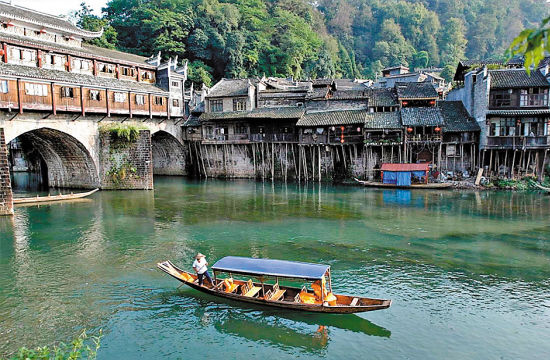
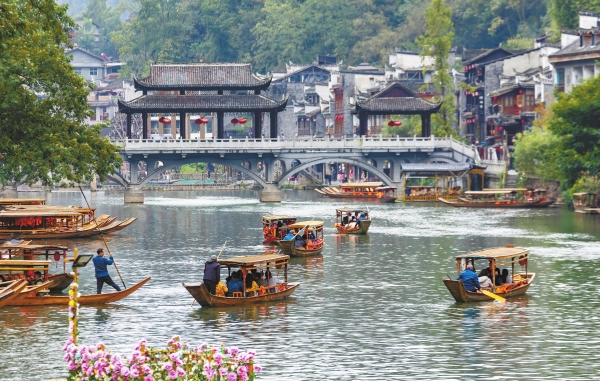
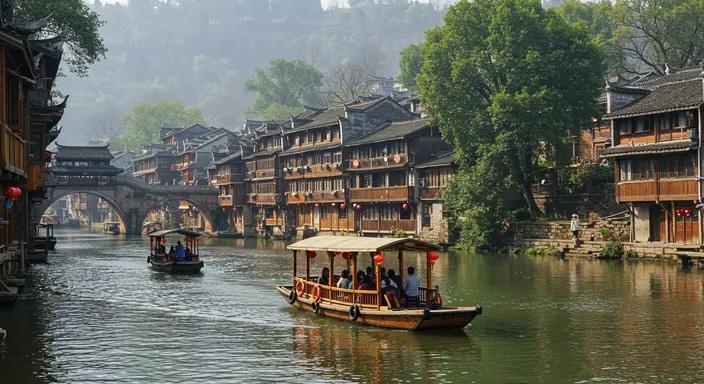
The classic Fenghuang hour — a wooden boat past the stilted houses, the bridges and the washing-lines, as the lanterns come on.
The 600-year-old covered bridge at the town's heart — tea rooms upstairs, market stalls below, the best balcony view of the river.
The 1,000+ hanging houses of the Miao-Tujia builders — wooden galleries, carved balconies and the laundry-blue river below.
The study of the writer of 'Border Town' — the small courtyard that gave China its most beloved river-town novel.
The 190-km Ming wall of the Miao frontier — the 'wall that held the Miao out' (or in), an hour from town.
When darkness falls the town lights its lanterns — the red-lit river and the night-market smoke are Fenghuang's second life.
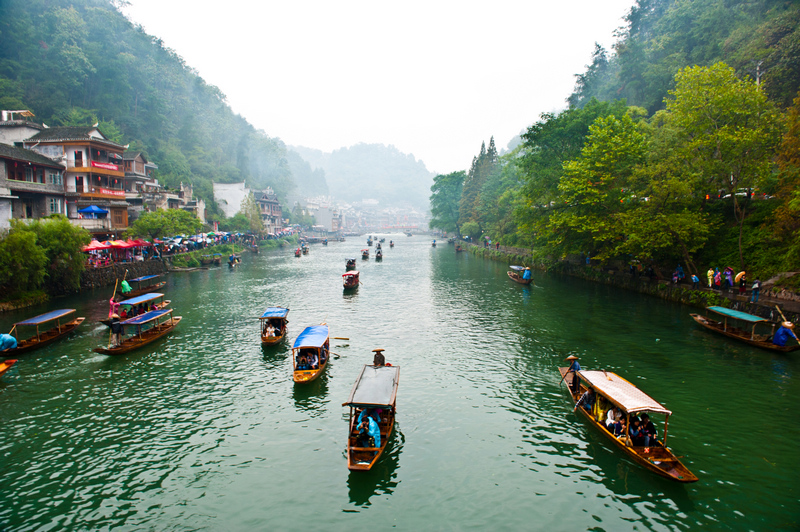
A jade-green river through a wooden town — the most romantic streetscape in western Hunan.
Batik, silverwork, the love-song festivals and the mountain villages around the town.
Fenghuang after dark is a different town — lanterns, river reflections and night markets.
Shen Congwen's 'Border Town' made the town a literary address — readers come for the novel's river.
March–June brings the greenest river and the Miao festivals; September–November is crisp and clear. Summer is busy and humid, winter quiet and cold — the town's lantern-lit lanes suit any season.
Two days is right: a day for the town, a morning boat ride and one night for the lanterns. Three days adds the Miao villages, the Southern Great Wall or the Qiliang Cave. The town is small — the charm is in lingering, not rushing.
By day, yes — the main lane is a souvenir strip. The fix is timing: dawn and late night belong to the real Fenghuang, and the back lanes behind the river hold the quiet town. A night stay is essential.
The nearest HSR station is Fenghuang Gudong (Phoenix Ancient Town) on the Zhangjiajie–Huaihua line — about 25 min by taxi from town. Zhangjiajie is 2.5–4 h by road, Changsha 5.5 h; tourist coaches run daily from both.
The riverside stilted hotels are the classic choice — wooden balconies over the Tuojiang. Book ahead: the best river rooms sell out weeks in advance. Quieter lanes behind the river cost half.
Yes — email [email protected] or message us on WhatsApp. We arrange riverside hotels, boat tickets, guides and transport from Zhangjiajie, free of charge.
The town by day, the river by dusk and the lanterns by night. View the plan →
Arrive, walk the stilted lanes to the Hongqiao Bridge, visit Shen Congwen's house and the Yang family ancestral hall; dusk boat on the Tuojiang, night market after dark.
Dawn along the river, the Miao museum and the town walls, then the east-gate view before the afternoon bus out.
Adds the Southern Great Wall, the Miao villages and the caves beyond the town. View the plan →
The town: Hongqiao, the lanes, Shen Congwen's house and the dusk boat.
The Southern Great Wall and Huangsiqiao ancient town in the morning, a Miao village (Laodong) for lunch and the mountain lanes after.
Qiliang Cave in the morning and the river once more before departure.
All plans are bookable end-to-end by our team — see the full day-by-day Fenghuang itineraries hub, or the day-trip pages for single-day options.
The jade-green river that made the town famous — wooden boats from the North Gate pier past the stilted houses and the bridges, best at dusk and dawn.
View details →The 600-year-old covered bridge at the town's heart — tea rooms and balconies upstairs, the market lane below, and the classic photograph of the river.
View details →The writer's childhood courtyard — the study, the river view and the beginnings of 'Border Town', China's most beloved river-town novel.
View details →The 190-km Ming wall of the Miao frontier at the town's west — watchtowers and mountain ridges, the 'Chinese Great Wall of the south'.
View details →A karst cave of stone forests and underground halls, 15 km from town — the region's big cave outing.
View details →The mountain villages of the Miao — silver jewellery, batik workshops, rice terraces and the hospitality of the border people.
View details →More in the region on the Hunan attractions page.
The Miao calendar brings bonfire nights, love songs and the silver-jewelled festival dress — spring and autumn are the loudest seasons.
Watch the wax-resist batik and the silversmiths at work in the town's craft houses — the border's living art.
Most evenings the riverside stages run folk music and the lantern boats set out — the town's second act after dark.
On the fifth day of the fifth lunar month the Tuojiang runs dragon boats — the border town's loudest festival.
Every hotel below is bookable by our team; browse the full Hunan hotels directory.
Wooden balconies over the Tuojiang — the postcard stay. From ¥250; river rooms book weeks ahead.
Quiet Miao-style courtyards behind the main lane — half the price, twice the peace. From ¥120.
The town's classic hotel by the north gate. From ¥400.
Newer design inns beside the covered bridge — the best balconies for the lantern view. From ¥300.
The HSR base 40 min away — the cheapest beds and the easy onward connection. From ¥150.
The border classics — blood tofu stew and the Miao sour-fish soup, served at every riverside table.
The local roast — salt-baked whole, eaten by hand at the night market.
The street snacks of the town — dark, rich and unlike anything in the cities.
The mountain staples — sticky rice, hanging-smoked pork and the sour-pickled vegetables of the border.
The famous silver headdresses, necklaces and bracelets — buy from the craft workshops, not the touts.
Wax-resist blue-and-white cloth — the border's signature textile, made in the town's dye houses.
The woven bands and pouches of the Tujia weavers.
Mountain tea and wild honey from the villages above the town.
Full local-product guides live on the Hunan specialties page.
The Phoenix Ancient Town station on the Zhangjiajie–Huaihua HSR puts the town 25 min away by taxi/shuttle — Changsha 4 h, Zhangjiajie 1.5 h. The old Jishou station remains for classic trains.
Direct tourist coaches run from Zhangjiajie (4 h), Changsha (5.5 h) and Huaihua (1.5 h) to the town gates — the standard budget route.
Tongren Fenghuang Airport (30 min) and Zhangjiajie Hehua (2.5 h by road) serve the main cities; shuttle coaches meet the flights.
Fenghuang is a walking town — the stilted lanes and bridges connect everything; the boat pier, the museums and the walls are all within 20 minutes.
Minibuses run the Southern Great Wall and the Miao villages from the town's east gate; a hired driver for the day runs ¥200–300.
The town's core is pedestrian — park at the official lots on the ring road and walk in; winter ice can close the high village roads.
The Ming wall of the Miao frontier and the stone ancient town beneath it — the border's military history in a day.
Silver, batik and mountain lanes — the living Miao village of the west, 40 min from town.
The karst cave of stone forests and halls, 15 km from the town.
The 'Heavenly Dragon Gorge' — waterfalls and cliff trails of the Miao mountains.
Fenghuang's magic is the dawn and the dark — the day-trippers leave by 17:00 and the lantern town belongs to overnighters.
The Tuojiang boats fill by mid-morning; the 8:00 departure gets the washing-lines, the mist and the empty river.
The town pass (¥148) covers Shen Congwen's house and the museums — if you only want the lanes and the river, walk free and buy single tickets.
Silver and batik prices at the main lane carry a tourist markup — the workshops behind the river are cheaper and better.
Fenghuang and Zhangjiajie are the classic two-stop west-Hunan route — 2.5–4 h apart by bus, or 1.5 h by the new HSR.
Fenghuang sits in the Xiangxi (western Hunan) mountains, on the Tuojiang River at the edge of the old Miao frontier — a humid subtropical climate of green hills, misty mornings and soft lantern-lit nights.
A fortified town from the Ming, Fenghuang was the military and trade hinge between the Han plain and the Miao mountains — the Southern Great Wall and the town walls are its frontier legacy. In the 20th century it produced the writer Shen Congwen, whose novel 'Border Town' (1934) turned the place into a literary landmark; the town's museum and the riverside still follow his descriptions.
The Miao and Tujia peoples built the stilted houses, sang the love songs and made the silver and batik that fill the craft lanes — a border culture of festivals, music and mountain hospitality that outlives the wall.
Everything on ToursChinaTravel is bookable through our team by email or WhatsApp. Here's where each part of your Fenghuang trip lives on the site.
Star-rated sight details — hours, tickets, phones and tips for every Hunan attraction.
Browse Hunan sightsStar-rated hotels across Hunan — sorted by rating, all bookable by our team.
Book a Hunan hotelLocal products, crafts and foods of Hunan — where to find each one.
Browse Hunan specialtiesLicensed agencies with addresses, phones and booking contacts.
Find a Hunan agencyMore city and region guides across China, including the Hunan guide.
Browse all guides